

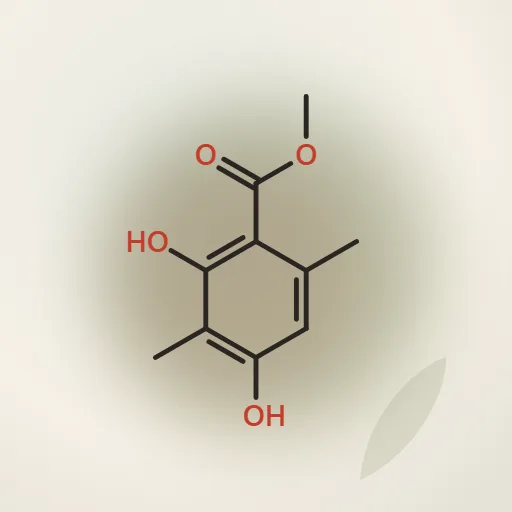
In short
Methyl atrarate is a constituent of oakmoss and the key material for oakmoss effects now that natural oakmoss is restricted. It has a mossy, earthy and woody odour.
What Methyl Atrarate smells like
Methyl atrarate (Evernyl, Givaudan; Veramoss, IFF) is a synthetic mossy note. De Hekserij finds it much less odorous than oakmoss and treemoss absolutes but the only other substance with certain of their characteristic mossy aspects. A vendor describes an earthy, mineral, mossy-woody note with a phenolic, medicinal nuance, cleaner and drier than oakmoss, with a burnt-vanilla sweetness; another dry, powdery and earthy. A perfumer on a forum finds it bland, rather chemical and medicinal, lacking oakmoss's complexity.
- Leading note
- Dry clean moss
- Supporting facets
- Earthy, mineral, phenolic, medicinal
- Faint facets
- Powdery, burnt vanilla
- Character
- Dry, clean, faint
What makes Methyl Atrarate distinctive
Oakmoss's mossy outline without its depth: a clean, dry, low-allergen replacement.
How Methyl Atrarate is used
Used as a partial replacement for oakmoss in chypre, fougère and woody compositions.
Typical role: fixative (slow to evaporate; helps a blend last and holds lighter notes); modifier (used in small amounts to change the character of a blend).
How Methyl Atrarate differs from similar materials
- Oakmoss Absolute
- Oakmoss is far stronger and more complex — damp, earthy, marine; methyl atrarate is a cleaner, drier, weaker moss. (compared directly by a cited source)
- Treemoss Absolute
- Treemoss is a full, dark, piney moss; methyl atrarate is much weaker and cleaner. (compared directly by a cited source)
An asterisk marks a difference that a cited source states directly. The others compare the published descriptions of each material. Smell varies with grade, supplier and dilution; compare them side by side on blotters before substituting one for another.
Formulation considerations
A solid that must be dissolved. It reproduces part of oakmoss's character, not all of it.
Identity and classification
- Type
- Aroma chemical
- Origin
- Occurs in nature
- Odour family
- Chypre / Woody
- Note position
- Base note
- Physical form at room temperature
- Solid
- Also known as
- Atraric acid, Methyl 2,4-dihydroxy-3,6-dimethylbenzoate, Veramoss
- CAS number
- 4707-47-5
- Molecular formula
- C10H12O4
- Molecular weight
- 196.2 g/mol
- IUPAC name
- methyl 2,4-dihydroxy-3,6-dimethylbenzoate
The CAS number, formula and molecular weight are taken from PubChem compound 78435, whose own record lists this CAS number; checked 19 October 2026.
Safety and compliance
Hazard classification of the neat substance, as PubChem summarises it, read 26 October 2026. Companies notifying the ECHA C&L Inventory report it as not meeting the GHS hazard criteria (1,537 of 1,706 reports). Unless it is harmonised, this is the notifiers' own classification, not a binding one.
This page is general information, not a safety assessment or a specification. Confirm identity, composition, IFRA status and allergen content from your supplier's documents for the lot you hold.
Materials it works with
-

 Oakmoss Absolute
Absolute · Chypre / Green — mossy, earthy, inky, forest floor
-

 Patchouli Oil
Essential oil · Woody / Chypre — earthy, woody, camphoraceous, dark
-
 Bergamot Oil (Expressed)
Essential oil · Citrus / Aromatic — citrus, zesty, floral, tea-like
-

 Labdanum Absolute
Absolute · Amber / Leather — amber, balsamic, leathery, animalic
Methyl Atrarate is also suggested as a partner on the pages for Oceanol and Treemoss Absolute.
Used in formulas and accords
Used in 46 published formulas
Methyl Atrarate is an ingredient in 29 perfume formulas, 14 accords and 3 bases in the Formula & Accord Library.
Community formulas
RUŌOD House Originals
Original compositions by RUŌOD House.
Further reading
Questions about Methyl Atrarate
Is Methyl Atrarate natural or synthetic?
The molecule occurs in nature. Commercial Methyl Atrarate may be made by synthesis or obtained from natural sources, so check the supplier's specification if the distinction matters to you.
What is the CAS number of Methyl Atrarate?
4707-47-5. It was checked against PubChem on 19 October 2026.
Which published formulas use Methyl Atrarate?
Methyl Atrarate is used in 46 published formulas in the RUŌOD Lab Formula & Accord Library, including Anise Ink, Asphalt Peony and Bitter Bridle. Each is listed with a link under "Used in formulas and accords" on this page.
Sources
- PubChem — compound 78435, checked 19 October 2026.
- PubChem — GHS classification (the ECHA C&L Inventory notifications and any harmonised EU entry), read 26 October 2026.
- De Hekserij — Methyl atratate — distributor's description.
- Premiere Peau — Evernyl — published perfumery reference.
- Basenotes — Oakmoss abs vs Evernyl (forum) — published perfumery reference.
- Olfactory profile: the RUŌOD Lab team's synthesis of the published descriptions above, reviewed 21 October 2026. Evidence: more than one published description. Classification and the short description: revision 1. Descriptions of odour are judgement, not measurement.