
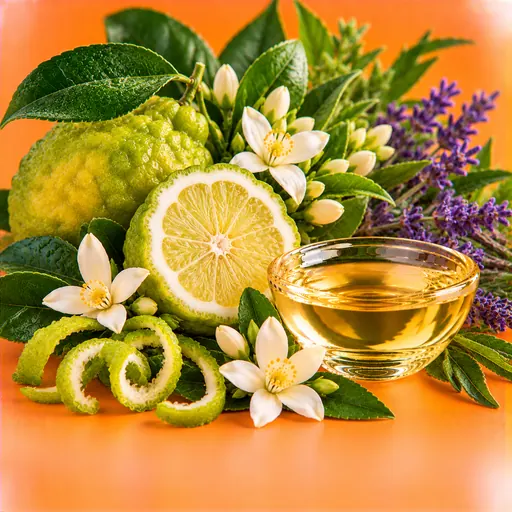

In short
Bergamot oil is the cold-expressed peel oil of the bergamot orange, grown mainly in Calabria, and the most widely used citrus in fine perfumery. It gives colognes, chypres and fougères their bright, slightly floral opening.
What Bergamot Oil (Expressed) smells like
Bergamot oil is bright, sweet and refreshing, with citrus and green notes over a light floral and bitter undertone. Its floral, tea-like and lavender-like lift comes from linalyl acetate and linalool, which make up a large part of the oil alongside limonene. It is softer and more floral than lemon or orange, and it fades quickly, leaving a faint green, slightly bitter trace.
- Leading note
- Sweet, bright citrus
- Clear facets
- Floral, lavender-like
- Supporting facets
- Tea-like, green
- Faint facets
- Bitter
- Character
- Bright, soft, fresh, fleeting
What makes Bergamot Oil (Expressed) distinctive
It is the floral citrus: its linalyl acetate and linalool give it a lavender- and tea-like softness that no other citrus peel has, which is why it opens so many colognes and chypres.
How Bergamot Oil (Expressed) is used
The classic top note of eau de cologne, chypre and fougère, and of Earl Grey tea. Expressed oil carries bergapten, which is phototoxic; furocoumarin-free (FCF) grades are used for products left on the skin.
Typical role: lift (adds diffusion and radiance, especially at the top); backbone (used in large proportions as a structural material of an accord).
How Bergamot Oil (Expressed) differs from similar materials
- Lemon Oil (Cold-Pressed)
- Lemon is sharper and more acidic; bergamot is softer, sweeter and more floral.
- Petitgrain Bigarade Oil
- A fragrance guide describes petitgrain, from the leaves, as the greenest and most herbaceous, and bergamot as the vibrant, citrusy one. (compared directly by a cited source)
- Bitter Orange Oil (Expressed)
- Arctander noted that bitter orange has notes recalling bergamot but is distinctly its own; bitter orange is drier and more austere, bergamot more floral and tea-like. (compared directly by a cited source)
- Linalyl Acetate
- Linalyl acetate supplies much of bergamot's floral, lavender-like lift on its own; the oil adds citrus peel, green and bitter notes.
- Bergamot Oil FCF
- The FCF grade has its furocoumarins removed; vacuum-distilled FCF oil is close in composition to the expressed oil and described as light and tangy.
An asterisk marks a difference that a cited source states directly. The others compare the published descriptions of each material. Smell varies with grade, supplier and dilution; compare them side by side on blotters before substituting one for another.
Formulation considerations
Expressed bergamot contains bergapten, a furocoumarin responsible for phototoxicity, which is why its use on skin is restricted. Bergapten-free (FCF) and distilled qualities exist for higher use levels. Like all expressed citrus oils it oxidises; store it cold, dark and full.
Identity and classification
- Type
- Essential oil
- Origin
- Natural
- Odour family
- Citrus / Aromatic
- Note position
- Top note
- Physical form at room temperature
- Liquid
- Also known as
- Bergamot essential oil
- Botanical source
- Citrus bergamia Risso & Poit.
- CAS number
- 8007-75-8
The CAS number was checked on 19 October 2026 against a PubChem substance record that gives it for this material. A natural material is a mixture, so it has no single formula; its composition varies with origin and processing.
Safety and compliance
The IFRA Standards Library lists a Standard covering Bergamot Oil (Expressed):
- "Bergamot oil expressed" — Restriction, 49th Amendment, published 2020-01
Limits differ by product category and are set out in the Standard itself; this page does not reproduce them. The list above reflects the library as read on 19 October 2026.
This page is general information, not a safety assessment or a specification. Confirm identity, composition, IFRA status and allergen content from your supplier's documents for the lot you hold.
Materials it works with
-

 Lemon Oil (Cold-Pressed)
Essential oil · Citrus / Aldehydic — citrus, sharp, zesty, juicy
-

 Lavender Oil
Essential oil · Aromatic / Floral — lavender, herbal, floral, fresh
-

 Neroli Oil
Essential oil · Floral / Citrus — floral, citrus, orange blossom, honeyed
-

 Petitgrain Bigarade Oil
Essential oil · Citrus / Floral — green, citrus, floral, bitter
-

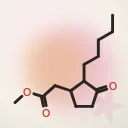 Hedione
Aroma chemical · Floral / Citrus — jasmine, transparent, citrus, airy
-

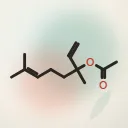 Linalyl Acetate
Aroma chemical · Aromatic / Fruity — fruity, floral, bergamot, lavender
Bergamot Oil (Expressed) is also suggested as a partner on the pages for Bergamot Oil FCF, Bitter Orange Oil (Expressed), Ethyl Linalool, Isocyclocitral, Methyl Nonyl Ketone and Myrac Aldehyde.
Used in formulas and accords
Used in 16 published formulas
Bergamot Oil (Expressed) is an ingredient in 12 accords and 4 bases in the Formula & Accord Library.
Further reading
Questions about Bergamot Oil (Expressed)
Is Bergamot Oil (Expressed) natural or synthetic?
Bergamot Oil (Expressed) is natural. It is a volatile oil obtained from plant material by steam distillation or, for citrus peels, by cold expression.
What is the CAS number of Bergamot Oil (Expressed)?
8007-75-8, the registry number for the essential oil as a substance rather than a single molecule. It was checked against PubChem on 19 October 2026.
Which published formulas use Bergamot Oil (Expressed)?
Bergamot Oil (Expressed) is used in 16 published formulas in the RUŌOD Lab Formula & Accord Library, including Blackberry Accord, Cannabis Base and Coquito Accord. Each is listed with a link under "Used in formulas and accords" on this page.
Is Bergamot Oil (Expressed) covered by an IFRA Standard?
Yes. The IFRA Standards Library lists a Standard covering it: "Bergamot oil expressed" — Restriction, 49th Amendment. The limits depend on the product category; read the Standard itself before formulating.
Sources
- PubChem — substance 485426779, checked 19 October 2026.
- IFRA — Standards Library, read 19 October 2026.
- Eden Botanicals — Bergamot — distributor's description.
- Fraterworks — Bergamot oil FCF organic — distributor's description.
- Premiere Peau — Bergamot — published perfumery reference.
- Scentspiracy — Linalyl acetate — distributor's description.
- Olfactory profile: the RUŌOD Lab team's synthesis of the published descriptions above, reviewed 24 October 2026. Evidence: several independent published descriptions, which agree. Classification and the short description: revision 1. Descriptions of odour are judgement, not measurement.