

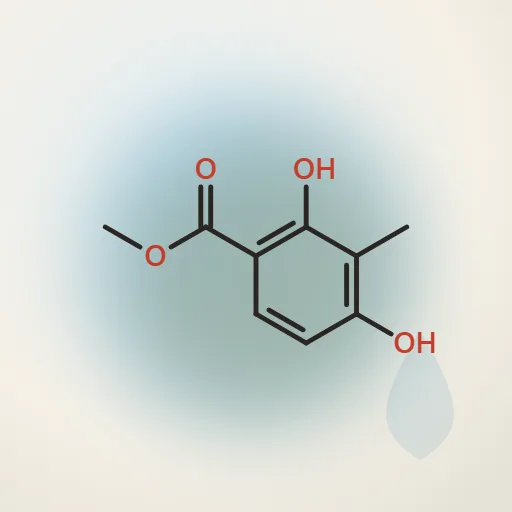
In short
Oceanol is a marine, mossy resorcylate ester, an IFF captive until 2024, closely related to Veramoss. It has a briny, seaweed-like, mineral character.
What Oceanol smells like
Fraterworks describes Oceanol, an IFF captive until 2024, as closely related to Veramoss but marine where that is dusty: a striking briny saltiness recalling sea spray drying on coastal rocks, an iodine-rich seaweed character over a fluffy, almost powdery texture, darker and more mineral than the melon aquatics, and a seldom-discussed orange-flower nuance. IFF's own sheet gives a fresh, ozonic marine top note that settles into earthy, mossy and woody dry-down notes, for watery marine accords and for leather and dark-wood fragrances. The Fragrance Foundry finds it close to Veramoss in smell and structure, with a slight swampy-marine facet.
- Leading note
- Briny seaweed
- Clear facets
- Mineral
- Supporting facets
- Powdery
- Faint facets
- Orange flower
- Character
- Diffusive, tenacious
What makes Oceanol distinctive
A mossy molecule turned towards the sea.
How Oceanol is used
Used in marine accords and in modern chypres to give an airy, oceanic alternative to oakmoss.
Typical role: modifier (used in small amounts to change the character of a blend); fixative (slow to evaporate; helps a blend last and holds lighter notes).
How Oceanol differs from similar materials
- Maritima
- Maritima is colder and metallic, sea spray and wet stone; Oceanol is brinier and seaweed-led, powdery and mossy.
- Red Seaweed CO2 Extract
- Red seaweed CO2 extract is a natural, rounded sea note with a gourmand side; Oceanol is brinier and iodine-rich.
Each difference compares the published descriptions of the two materials. Smell varies with grade, supplier and dilution; compare them side by side on blotters before substituting one for another.
Formulation considerations
A very powerful powder, usually handled as a dilution.
Identity and classification
- Type
- Aroma chemical
- Origin
- Synthetic
- Odour family
- Aquatic / Chypre
- Note position
- Heart to base note
- Physical form at room temperature
- Solid
- Also known as
- Methyl 2,4-dihydroxy-3-methylbenzoate, Seamoss
- CAS number
- 33662-58-7
- Molecular formula
- C9H10O4
- Molecular weight
- 182.17 g/mol
- IUPAC name
- methyl 2,4-dihydroxy-3-methylbenzoate
The CAS number, formula and molecular weight are taken from PubChem compound 118521, whose own record lists this CAS number; checked 24 October 2026.
Safety and compliance
Hazard classification of the neat substance, as PubChem summarises it, read 26 October 2026. Companies notifying the ECHA C&L Inventory classify it (166 reports): H317 may cause an allergic skin reaction (29.5% of reports); H302 harmful if swallowed (24.1% of reports); H315 causes skin irritation (24.1% of reports); H319 causes serious eye irritation (24.1% of reports); H335 may cause respiratory irritation (24.1% of reports). 77 of the reports find it does not meet the hazard criteria. A skin sensitiser classification concerns handling the neat material and the dose in a finished product; the IFRA Standards, where they apply, set the limits. Unless it is harmonised, this is the notifiers' own classification, not a binding one.
This page is general information, not a safety assessment or a specification. Confirm identity, composition, IFRA status and allergen content from your supplier's documents for the lot you hold.
Materials it works with
-

 Methyl Atrarate
Aroma chemical · Chypre / Woody — mossy, earthy, woody, phenolic
-
 Calone
Aroma chemical · Aquatic / Metallic — marine, watermelon, ozonic, watery
-

 Oakmoss Absolute
Absolute · Chypre / Green — mossy, earthy, inky, forest floor
Oceanol is also suggested as a partner on the pages for Red Seaweed CO2 Extract.
Used in formulas and accords
Used in 7 published formulas
Oceanol is an ingredient in 5 perfume formulas and 2 accords in the Formula & Accord Library.
Community formulas
RUŌOD House Originals
Original compositions by RUŌOD House.
Further reading
Questions about Oceanol
Is Oceanol natural or synthetic?
Oceanol is synthetic — it is made by chemical synthesis.
What is the CAS number of Oceanol?
33662-58-7. It was checked against PubChem on 24 October 2026.
Which published formulas use Oceanol?
Oceanol is used in 7 published formulas in the RUŌOD Lab Formula & Accord Library, including Bleached Driftwood, Harbour Rope and Low Tide Library. Each is listed with a link under "Used in formulas and accords" on this page.
Sources
- PubChem — compound 118521, checked 24 October 2026.
- PubChem — GHS classification (the ECHA C&L Inventory notifications and any harmonised EU entry), read 26 October 2026.
- Fraterworks — Oceanol — distributor's description.
- PubChem — methyl 2,4-dihydroxy-3-methylbenzoate (CID 118521) — odour database.
- IFF — Oceanol — manufacturer's description.
- The Fragrance Foundry — Oceanol (IFF) — distributor's description.
- Olfactory profile: the RUŌOD Lab team's synthesis of the published descriptions above, reviewed 26 October 2026. Evidence: more than one published description. Classification and the short description: revision 1. Descriptions of odour are judgement, not measurement.