

In short
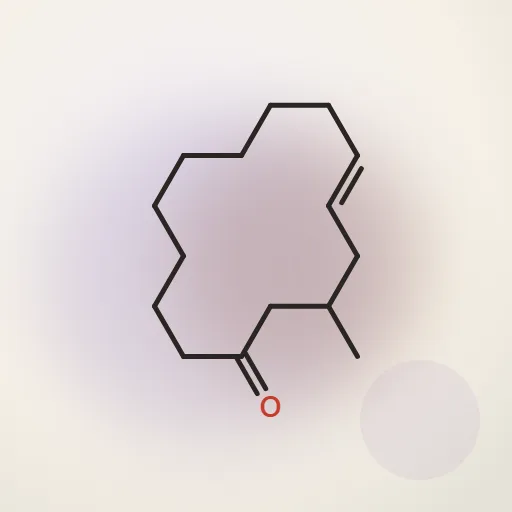
Cosmone is a trade name for a macrocyclic ketone musk with a warm, powdery and slightly animalic character. It is powerful and diffusive for a musk.
What Cosmone smells like
Cosmone (Givaudan) is a very rich, intense and diffusive musky note with warm and powdery facets, reminiscent of ambergris, with sweet aspects of nitro musks, in Givaudan's description. Third-party descriptions add anisic and faintly fruity nuances. A forum thread claims it was discontinued, which was not confirmed by Givaudan.
- Leading note
- Rich warm musk
- Supporting facets
- Powdery, ambergris
- Faint facets
- Anisic
- Character
- Rich, intense, diffusive
What makes Cosmone distinctive
A rich macrocyclic musk with an ambergris glow and the sweetness of the old nitro musks.
How Cosmone is used
Used as a rich, diffusive musk in fine fragrance and amber compositions.
Typical role: fixative (slow to evaporate; helps a blend last and holds lighter notes); modifier (used in small amounts to change the character of a blend).
How Cosmone differs from similar materials
- Muscenone
- Muscenone is more animal; Cosmone is richer, with ambergris and warm powder.
- Velvione
- Velvione is a powdery macrocyclic musk with animalic, civet-like aspects; Cosmone is warmer, with ambergris.
Each difference compares the published descriptions of the two materials. Smell varies with grade, supplier and dilution; compare them side by side on blotters before substituting one for another.
Identity and classification
- Type
- Aroma chemical
- Origin
- Synthetic
- Odour family
- Musky / Animalic
- Note position
- Base note
- Physical form at room temperature
- Liquid
- Also known as
- (Z)-3-Methylcyclotetradec-5-en-1-one
- CAS number
- 259854-70-1
- Molecular formula
- C15H26O
- Molecular weight
- 222.37 g/mol
- IUPAC name
- (5E)-3-methylcyclotetradec-5-en-1-one
The CAS number, formula and molecular weight are taken from PubChem compound 66823518, whose own record lists this CAS number; checked 19 October 2026.
Safety and compliance
Hazard classification of the neat substance, as PubChem summarises it, read 26 October 2026. Companies notifying the ECHA C&L Inventory classify it (220 reports): H317 may cause an allergic skin reaction (100% of reports); H410 very toxic to aquatic life with long lasting effects (85.9% of reports); H400 very toxic to aquatic life (65.9% of reports); H302 harmful if swallowed (14.1% of reports); H373 may causes damage to organs through prolonged or repeated exposure (14.1% of reports). A skin sensitiser classification concerns handling the neat material and the dose in a finished product; the IFRA Standards, where they apply, set the limits. Unless it is harmonised, this is the notifiers' own classification, not a binding one.
This page is general information, not a safety assessment or a specification. Confirm identity, composition, IFRA status and allergen content from your supplier's documents for the lot you hold.
Materials it works with
-

 Muscenone
Aroma chemical · Musky / Animalic — musky, animalic, warm, powdery
-

 Habanolide
Aroma chemical · Musky / Metallic — musky, clean, metallic, powdery
-

 Ambrettolide
Aroma chemical · Musky / Fruity — musky, ambrette, fruity, pear
-

 Exaltone
Aroma chemical · Musky / Animalic — musky, animalic, warm
Used in formulas and accords
Used in 23 published formulas
Cosmone is an ingredient in 21 perfume formulas, 1 accord and 1 base in the Formula & Accord Library.
Community formulas
RUŌOD House Originals
Original compositions by RUŌOD House.
Further reading
Questions about Cosmone
Is Cosmone natural or synthetic?
Cosmone is synthetic — it is made by chemical synthesis.
What is the CAS number of Cosmone?
259854-70-1. It was checked against PubChem on 19 October 2026.
Which published formulas use Cosmone?
Cosmone is used in 23 published formulas in the RUŌOD Lab Formula & Accord Library, including Apple Cellar, Beeswax Throne and Black Saddle. Each is listed with a link under "Used in formulas and accords" on this page.
Sources
- PubChem — compound 66823518, checked 19 October 2026.
- PubChem — GHS classification (the ECHA C&L Inventory notifications and any harmonised EU entry), read 26 October 2026.
- Givaudan — Cosmone — manufacturer's description.
- The Good Scents Company — Cosmone — odour database.
- Basenotes — Thoughts on Cosmone (forum) — published perfumery reference.
- Olfactory profile: the RUŌOD Lab team's synthesis of the published descriptions above, reviewed 21 October 2026. Evidence: more than one published description. Classification and the short description: revision 1. Descriptions of odour are judgement, not measurement.