

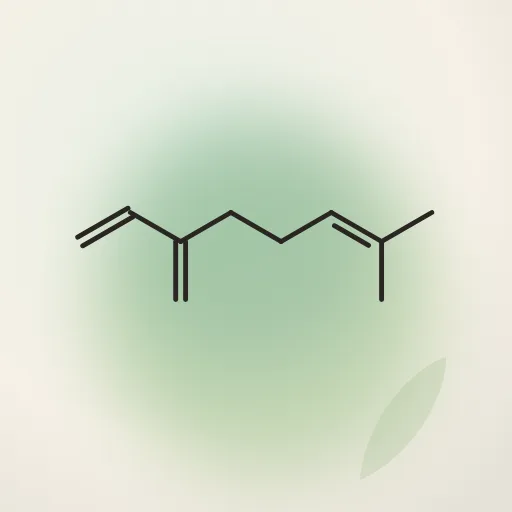
In short
Myrcene is an acyclic monoterpene found in hops, bay, lemongrass and many other oils. It has a herbal, balsamic odour and is the starting point for many aroma chemicals.
What Myrcene smells like
Myrcene is a light, volatile terpene with a sweet, balsamic-resinous character. Arctander, as quoted by The Good Scents Company, describes it as refreshing, almost citrusy, but warm-balsamic and ethereal-sweet. Suppliers describe a sweet, balsamic, resinous odour with fruity-green and citrus nuances; Takasago a sweet-balsamic, resinous 'gum' odour of poor tenacity; and others herbaceous and woody notes. It is short-lived — under an hour on a blotter.
- Leading note
- Sweet balsamic-resinous
- Supporting facets
- Citrus-like freshness, herbaceous
- Faint facets
- Fruity-green
- Character
- Light, sweet, ethereal, fleeting
What makes Myrcene distinctive
It is a warm, balsamic terpene rather than a sharp one: refreshing and almost citrusy like the citrus terpenes, but with a resinous, gum-like sweetness. It is the main volatile of hop oil.
Where the descriptions disagree: A metallic note appears only in one consumer glossary; supplier and reference descriptions do not mention it.
How Myrcene is used
Used for a fresh, spicy-refreshing lift in citrus and spice colognes, as Arctander notes, and as a starting material for other fragrance chemicals. Its poor tenacity limits it to the top note.
Typical role: modifier (used in small amounts to change the character of a blend).
How Myrcene differs from similar materials
- beta-Ocimene
- Beta-ocimene is warmer, more floral and herbaceous; myrcene is more balsamic-resinous and citrus-fresh.
- Hop Oil
- Myrcene is the dominant constituent of hop oil; the oil adds the spicy, woody humulene and caryophyllene notes that make it 'hoppy'.
- Juniper Berry Oil
- Juniper berry owes part of its peppery warmth to myrcene, inside a sparkling, terpenic, gin-like berry. (compared directly by a cited source)
An asterisk marks a difference that a cited source states directly. The others compare the published descriptions of each material. Smell varies with grade, supplier and dilution; compare them side by side on blotters before substituting one for another.
Formulation considerations
Polymerises and oxidises readily; store cold and use fresh.
Identity and classification
- Type
- Aroma chemical
- Origin
- Occurs in nature
- Odour family
- Green / Aromatic
- Note position
- Top note
- Physical form at room temperature
- Liquid
- Also known as
- beta-Myrcene, 7-Methyl-3-methyleneocta-1,6-diene
- CAS number
- 123-35-3
- Molecular formula
- C10H16
- Molecular weight
- 136.23 g/mol
- IUPAC name
- 7-methyl-3-methylideneocta-1,6-diene
The CAS number, formula and molecular weight are taken from PubChem compound 31253, whose own record lists this CAS number; checked 19 October 2026.
Safety and compliance
Hazard classification of the neat substance, as PubChem summarises it, read 26 October 2026. Companies notifying the ECHA C&L Inventory classify it (2,180 reports): H226 flammable liquid and vapor (99.8% of reports); H304 may be fatal if swallowed and enters airways (99% of reports); H315 causes skin irritation (85.6% of reports); H319 causes serious eye irritation (85.5% of reports); H412 harmful to aquatic life with long lasting effects (18.7% of reports); H400 very toxic to aquatic life (14.6% of reports). Unless it is harmonised, this is the notifiers' own classification, not a binding one.
This page is general information, not a safety assessment or a specification. Confirm identity, composition, IFRA status and allergen content from your supplier's documents for the lot you hold.
Materials it works with
-

 alpha-Pinene
Aroma chemical · Aromatic / Woody — piney, resinous, fresh, turpentine
-

 d-Limonene
Aroma chemical · Citrus / Fruity — citrus, orange, fresh, light
-

 Hop Oil
Essential oil · Green / Spicy — green, herbal, spicy, resinous
-
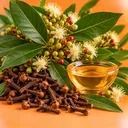
 Bay Oil (West Indian)
Essential oil · Spicy / Aromatic — spicy, clove, fresh, herbal
Myrcene is also suggested as a partner on the pages for alpha-Humulene and beta-Ocimene.
Used in formulas and accords
Used in 4 published formulas
Myrcene is an ingredient in 2 accords and 2 bases in the Formula & Accord Library.
Further reading
Questions about Myrcene
Is Myrcene natural or synthetic?
The molecule occurs in nature. Commercial Myrcene may be made by synthesis or obtained from natural sources, so check the supplier's specification if the distinction matters to you.
What is the CAS number of Myrcene?
123-35-3. It was checked against PubChem on 19 October 2026.
Which published formulas use Myrcene?
Myrcene is used in 4 published formulas in the RUŌOD Lab Formula & Accord Library, including Cannabis Base, Fig Accord and Mango Accord. Each is listed with a link under "Used in formulas and accords" on this page.
Sources
- PubChem — compound 31253, checked 19 October 2026.
- PubChem — GHS classification (the ECHA C&L Inventory notifications and any harmonised EU entry), read 26 October 2026.
- The Good Scents Company — myrcene (quoting Arctander) — odour database.
- Scentspiracy — Myrcene — distributor's description.
- Fraterworks — myrcene — distributor's description.
- Wikipedia — Myrcene — published perfumery reference.
- Olfactory profile: the RUŌOD Lab team's synthesis of the published descriptions above, reviewed 21 October 2026. Evidence: more than one published description. Classification and the short description: revision 1. Descriptions of odour are judgement, not measurement.