
In short
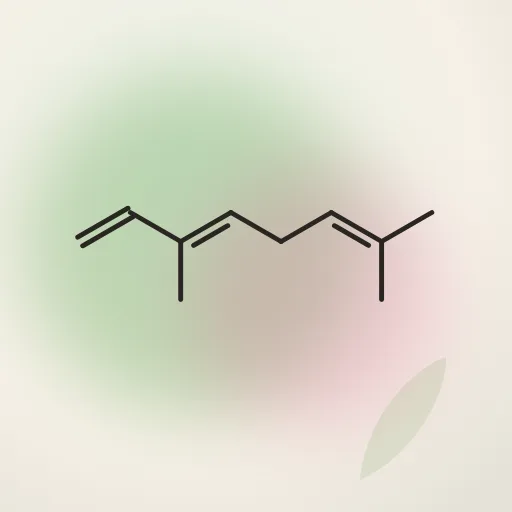
beta-Ocimene is an acyclic monoterpene found in basil, lavender, tagetes and many flowers. It gives a warm, green-floral and herbal note.
What beta-Ocimene smells like
Beta-ocimene is a warm, herbaceous terpene with a sweet floral side. Database entries describe the cis isomer as warm, floral and sweet, and ChemicalBook gives warm and herbaceous for the material in general; Wikipedia notes that the ocimenes are used in perfumery for their sweet herbal scent. Supplier specifications vary more, from warm, floral and woody to tropical, green and terpenic with vegetable nuances — the commercial material is a mixture of isomers.
- Leading note
- Warm herbal
- Clear facets
- Sweet floral
- Supporting facets
- Green
- Faint facets
- Woody, tropical
- Character
- Warm, sweet, green, light
What makes beta-Ocimene distinctive
Its floral sweetness. Among the light terpenes it is warmer and more flowery — closer to an herb in bloom than to pine or citrus.
Where the descriptions disagree: Supplier specifications range from warm, floral and woody to tropical, green and terpenic; the isomer mixture differs between grades.
How beta-Ocimene is used
Used for a sweet herbal, green-floral freshness in top notes, and in reconstructions of oils such as basil and lavender, in which it occurs.
Typical role: modifier (used in small amounts to change the character of a blend).
How beta-Ocimene differs from similar materials
- Myrcene
- Myrcene is more balsamic-resinous and citrus-fresh; beta-ocimene is warmer, sweeter and more floral-herbaceous.
- Alpha Farnesene
- alpha-Farnesene is the heavier sesquiterpene, celery-green and myrrh-like; ocimene is lighter and more flowery.
Each difference compares the published descriptions of the two materials. Smell varies with grade, supplier and dilution; compare them side by side on blotters before substituting one for another.
Formulation considerations
Unstable in air; store cold and use fresh.
Identity and classification
- Type
- Aroma chemical
- Origin
- Occurs in nature
- Odour family
- Green / Floral
- Note position
- Top note
- Physical form at room temperature
- Liquid
- Also known as
- 3,7-Dimethylocta-1,3,6-triene
- CAS number
- 13877-91-3
- Molecular formula
- C10H16
- Molecular weight
- 136.23 g/mol
- IUPAC name
- 3,7-dimethylocta-1,3,6-triene
The CAS number, formula and molecular weight are taken from PubChem compound 18756, whose own record lists this CAS number; checked 19 October 2026.
Safety and compliance
Hazard classification of the neat substance, as PubChem summarises it, read 26 October 2026. Companies notifying the ECHA C&L Inventory classify it (1,922 reports): H226 flammable liquid and vapor (98.1% of reports); H304 may be fatal if swallowed and enters airways (96% of reports); H412 harmful to aquatic life with long lasting effects (70% of reports). 37 of the reports find it does not meet the hazard criteria. Unless it is harmonised, this is the notifiers' own classification, not a binding one.
This page is general information, not a safety assessment or a specification. Confirm identity, composition, IFRA status and allergen content from your supplier's documents for the lot you hold.
Materials it works with
-

 Myrcene
Aroma chemical · Green / Aromatic — herbal, balsamic, green, resinous
-

 Linalool
Aroma chemical · Floral / Citrus — floral, fresh, woody, citrus
-

 Lavender Oil
Essential oil · Aromatic / Floral — lavender, herbal, floral, fresh
-
 Basil Oil
Essential oil · Aromatic / Spicy — herbal, green, aniseed, fresh
Used in formulas and accords
Used in 1 published formula
beta-Ocimene is an ingredient in 1 perfume formula in the Formula & Accord Library.
RUŌOD House Originals
Original compositions by RUŌOD House.
Further reading
Questions about beta-Ocimene
Is beta-Ocimene natural or synthetic?
The molecule occurs in nature. Commercial beta-Ocimene may be made by synthesis or obtained from natural sources, so check the supplier's specification if the distinction matters to you.
What is the CAS number of beta-Ocimene?
13877-91-3. It was checked against PubChem on 19 October 2026.
Which published formulas use beta-Ocimene?
beta-Ocimene is used in 1 published formula in the RUŌOD Lab Formula & Accord Library: Cut Stem Atelier. Each is listed with a link under "Used in formulas and accords" on this page.
Sources
- PubChem — compound 18756, checked 19 October 2026.
- PubChem — GHS classification (the ECHA C&L Inventory notifications and any harmonised EU entry), read 26 October 2026.
- Wikipedia — Ocimene — published perfumery reference.
- FooDB — cis-beta-ocimene — odour database.
- ChemicalBook — ocimene (CAS 13877-91-3) — odour database.
- Parchem — beta-ocimene — distributor's description.
- Olfactory profile: the RUŌOD Lab team's synthesis of the published descriptions above, reviewed 26 October 2026. Evidence: more than one published description. Classification and the short description: revision 1. Descriptions of odour are judgement, not measurement.