
In short
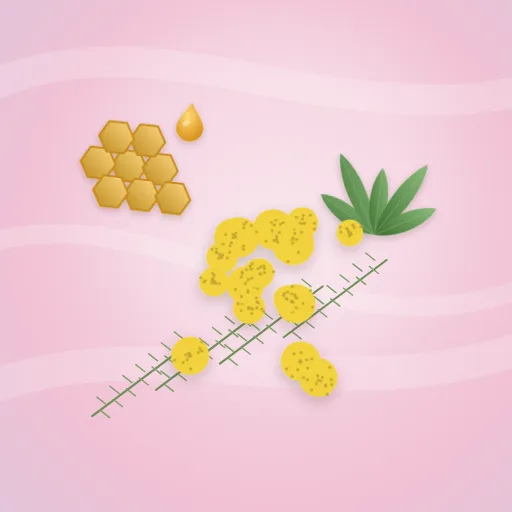
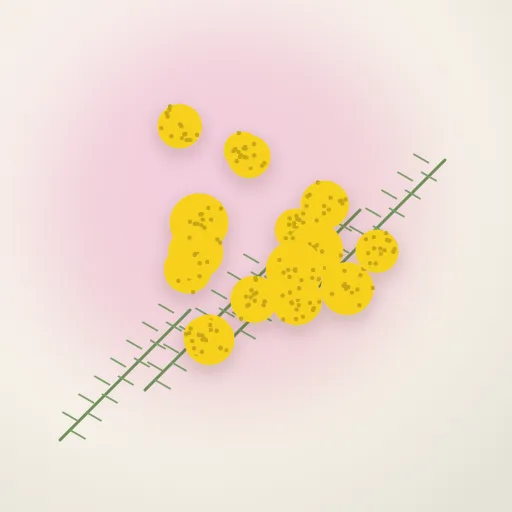
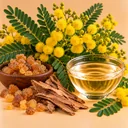
Mimosa absolute is extracted from the flowers of Acacia dealbata, mainly in southern France and India. It is a powdery, green-floral material associated with spring.
What Mimosa Absolute smells like
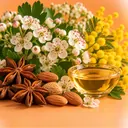
Mimosa absolute is a soft, sweet-powdery, honey-like floral, very powdery and dry — even dusty — with a straw-like, honeyed character and gentle green and woody back notes. Because the leaves are extracted with the flower balls, it has light green accents of cucumber or even melon. Sources add a violet-anisic sweetness, a coumarinic warmth like dried grass, and a slightly animalic, cassie-like depth in the base.
- Leading note
- Powdery honey
- Supporting facets
- Green, cucumber, violet-anisic, hay, straw
- Faint facets
- Woody
- Character
- Powdery, dry, soft, honeyed
What makes Mimosa Absolute distinctive
Dusty, honeyed powder with a cucumber-green edge from the leaves — drier and more hay-like than cassie.
How Mimosa Absolute is used
Used as a heart-note accent in floral accords, with rose, tuberose or jasmine, and with orris, violet or carrot seed to accentuate its powder.
Typical role: modifier (used in small amounts to change the character of a blend).
How Mimosa Absolute differs from similar materials
- Cassie Absolute
- Cassie is greener, spicier and more diffusive; mimosa is more powdery, dusty and honeyed, with hay. (compared directly by a cited source)
- Linden Blossom Absolute
- Linden is a greener honey, with lemon and tea; mimosa is powdery and violet-like, with a green-woody side.
An asterisk marks a difference that a cited source states directly. The others compare the published descriptions of each material. Smell varies with grade, supplier and dilution; compare them side by side on blotters before substituting one for another.
Formulation considerations
Viscous and dark; warm and dilute it before weighing.
Identity and classification
- Type
- Absolute
- Origin
- Natural
- Odour family
- Floral / Powdery
- Note position
- Heart note
- Physical form at room temperature
- Liquid
- Botanical source
- Acacia dealbata Link
- CAS number
- 8031-03-6
The CAS number was checked on 19 October 2026 against a PubChem substance record that gives it for this material. A natural material is a mixture, so it has no single formula; its composition varies with origin and processing.
Safety and compliance
This page is general information, not a safety assessment or a specification. Confirm identity, composition, IFRA status and allergen content from your supplier's documents for the lot you hold.
Materials it works with
-

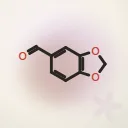 Heliotropin
Aroma chemical · Powdery / Gourmand — powdery, almond, vanilla, floral
-

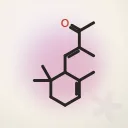 alpha-Isomethyl Ionone
Aroma chemical · Powdery / Floral — powdery, violet, orris, woody
-
 Violet Leaf Absolute
Absolute · Green / Aquatic — green, leafy, cucumber, watery
-
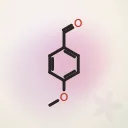 Anisaldehyde
Aroma chemical · Powdery / Floral — anisic, hawthorn, floral, sweet
-
 Cassie Absolute
Absolute · Floral / Powdery — powdery, violet, spicy, honey
Mimosa Absolute is also suggested as a partner on the pages for 4-Methylacetophenone, Acetophenone, Canthoxal, Mimosal and Peomosa.
Used in formulas and accords
Used in 5 published formulas
Mimosa Absolute is an ingredient in 4 perfume formulas and 1 accord in the Formula & Accord Library.
Community formulas
RUŌOD House Originals
Original compositions by RUŌOD House.
Further reading
Questions about Mimosa Absolute
Is Mimosa Absolute natural or synthetic?
Mimosa Absolute is natural. It is a concentrated extract obtained from plant material with a solvent, then washed with ethanol to remove the waxes.
What is the CAS number of Mimosa Absolute?
8031-03-6, the registry number for the absolute as a substance rather than a single molecule. It was checked against PubChem on 19 October 2026.
Which published formulas use Mimosa Absolute?
Mimosa Absolute is used in 5 published formulas in the RUŌOD Lab Formula & Accord Library, including Beeswax Throne, Linden Afternoon and Mimosa Accord. Each is listed with a link under "Used in formulas and accords" on this page.
Sources
- PubChem — substance 135345770, checked 19 October 2026.
- Sylvaine Delacourte — Mimosa in perfumery — published perfumery reference.
- Premiere Peau — Mimosa absolute — published perfumery reference.
- Scentspiracy — Mimosa concrete / absolute — distributor's description.
- Olfactory profile: the RUŌOD Lab team's synthesis of the published descriptions above, reviewed 20 October 2026. Evidence: more than one published description. Classification and the short description: revision 1. Descriptions of odour are judgement, not measurement.