
In short
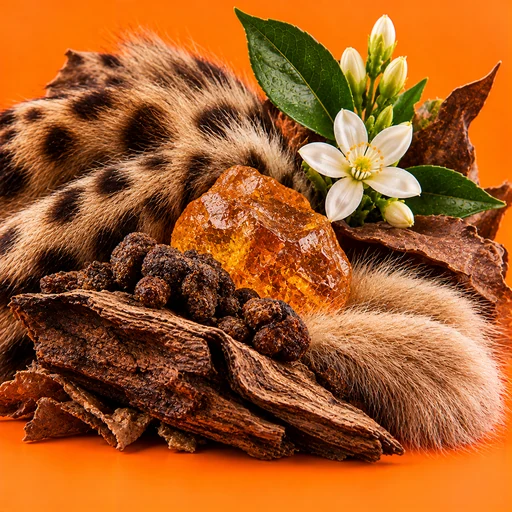
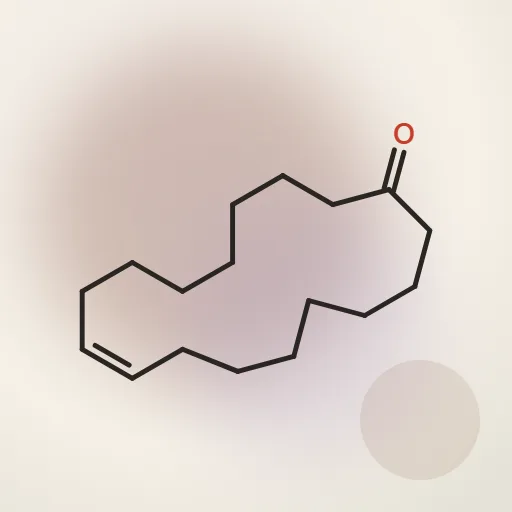
Civetone is a macrocyclic ketone and the principal odorant of civet, the secretion once collected from civet cats. Perfumery now uses the synthetic molecule, which gives an animalic musk in tiny amounts.
What Civetone smells like
Civetone, the main odorant of civet, is described as a delicately sweet, animal, musky odour, more muscular than Exaltone but not unpleasant, by one supplier, and as warm, musky, animalic, powdery and delicately sweet, with high diffusion and tenacity, by another. A glossary describes the neat material as powerfully animalic and faecal, with a faintly sweet, almost honeyed quality at functional concentrations. Other descriptions add leather and fur. Wikipedia identifies it as (9Z)-cycloheptadec-9-en-1-one, the main odorous constituent of civet, with a strong musky odour that becomes pleasant at extreme dilutions, and notes that it is now made from precursors found in palm oil.
- Leading note
- Animalic musk
- Supporting facets
- Warm, sweet, faecal
- Faint facets
- Leather, fur, powdery
- Character
- Warm, diffusive, tenacious, animalic
What makes Civetone distinctive
The civet note made synthetic: faecal neat, warmly sweet and furry in a composition.
Concentration and dilution
Powerfully animalic and faecal neat; faintly sweet, almost honeyed at functional concentrations.
How Civetone is used
Used in traces for animalic warmth in floral, chypre and oriental compositions.
Typical role: modifier (used in small amounts to change the character of a blend); fixative (slow to evaporate; helps a blend last and holds lighter notes).
How Civetone differs from similar materials
- Exaltone
- One supplier finds civetone more muscular than Exaltone; Exaltone is the softer, sweeter musk. (compared directly by a cited source)
- Velvione
- Velvione is a powdery musk with civet-like aspects; civetone is the animal note itself.
- Skatole
- Skatole is faecal and indolic; civetone is a warmer, musky animal note with sweetness in dilution.
An asterisk marks a difference that a cited source states directly. The others compare the published descriptions of each material. Smell varies with grade, supplier and dilution; compare them side by side on blotters before substituting one for another.
Formulation considerations
Extremely powerful; work from a 0.1% dilution. The material in use is synthetic, so no animal is involved.
Identity and classification
- Type
- Aroma chemical
- Origin
- Occurs in nature
- Odour family
- Animalic / Musky
- Note position
- Base note
- Physical form at room temperature
- Solid. A white or colourless crystalline mass, in JECFA's description as PubChem publishes it.
- Also known as
- (Z)-Cycloheptadec-9-en-1-one
- CAS number
- 542-46-1
- Molecular formula
- C17H30O
- Molecular weight
- 250.4 g/mol
- IUPAC name
- (9Z)-cycloheptadec-9-en-1-one
The CAS number, formula and molecular weight are taken from PubChem compound 5315941, whose own record lists this CAS number; checked 19 October 2026.
Safety and compliance
Hazard classification of the neat substance, as PubChem summarises it, read 26 October 2026. Companies notifying the ECHA C&L Inventory classify it (187 reports): H315 causes skin irritation (20.9% of reports). 148 of the reports find it does not meet the hazard criteria. Unless it is harmonised, this is the notifiers' own classification, not a binding one.
This page is general information, not a safety assessment or a specification. Confirm identity, composition, IFRA status and allergen content from your supplier's documents for the lot you hold.
Materials it works with
-

 Muscone
Aroma chemical · Musky / Animalic — musky, animalic, warm, powdery
-

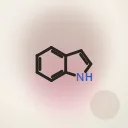 Indole
Aroma chemical · Animalic / Floral — animalic, indolic, floral, narcotic
-

 Jasmine Absolute (Grandiflorum)
Absolute · Floral / Animalic — jasmine, floral, indolic, fruity
-

 Labdanum Absolute
Absolute · Amber / Leather — amber, balsamic, leathery, animalic
Civetone is also suggested as a partner on the pages for Civet Absolute, Costus Oliffac and Tonquitone.
Used in formulas and accords
Used in 8 published formulas
Civetone is an ingredient in 6 perfume formulas and 2 accords in the Formula & Accord Library.
Community formulas
RUŌOD House Originals
Original compositions by RUŌOD House.
Further reading
Questions about Civetone
Is Civetone natural or synthetic?
The molecule occurs in nature. Commercial Civetone may be made by synthesis or obtained from natural sources, so check the supplier's specification if the distinction matters to you.
What is the CAS number of Civetone?
542-46-1. It was checked against PubChem on 19 October 2026.
Which published formulas use Civetone?
Civetone is used in 8 published formulas in the RUŌOD Lab Formula & Accord Library, including Bright Wolf, Feral Jasmine Accord and Lilac Accord. Each is listed with a link under "Used in formulas and accords" on this page.
Sources
- PubChem — compound 5315941, checked 19 October 2026.
- PubChem — GHS classification (the ECHA C&L Inventory notifications and any harmonised EU entry), read 26 October 2026.
- Scentspiracy — Civetone — distributor's description.
- Premiere Peau — Civettone — published perfumery reference.
- Parfinity — Civettone — published perfumery reference.
- Wikipedia — Civetone — published perfumery reference.
- Olfactory profile: the RUŌOD Lab team's synthesis of the published descriptions above, reviewed 26 October 2026. Evidence: more than one published description. Classification and the short description: revision 1. Descriptions of odour are judgement, not measurement.