
In short
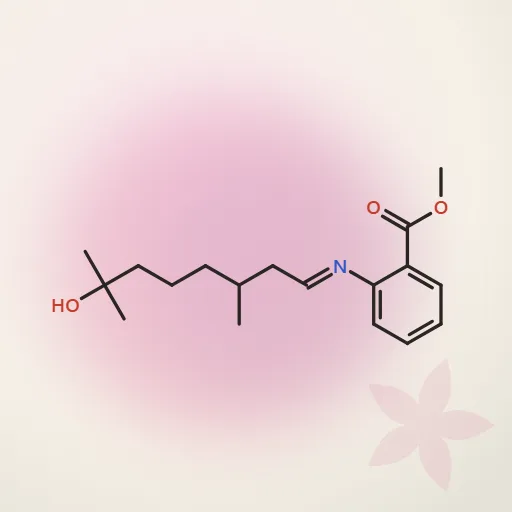
Aurantiol is the Schiff base formed from hydroxycitronellal and methyl anthranilate. It gives a heavy, sweet orange-blossom note with great tenacity.
What Aurantiol smells like
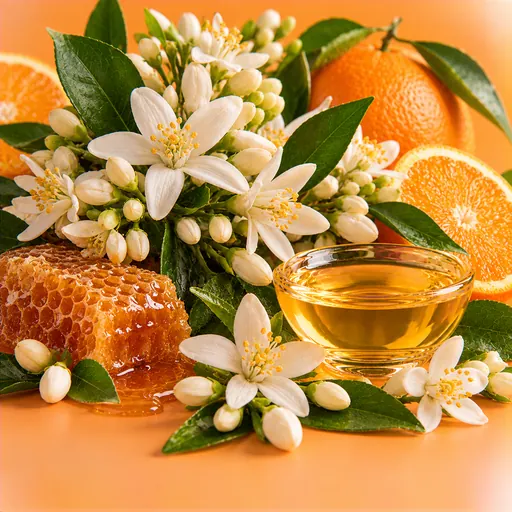
Aurantiol, the Schiff base of methyl anthranilate and hydroxycitronellal, is a floral-balsamic, sweet orange-blossom material. A 2018 study found its synthesised product floral-balsamic, sweet and orange-blossom-like; a supplier lists floral-orange blossom, slightly sweet, powdery and faintly balsamic. A glossary adds honeyed warmth and a slightly animalic undertone, describing it as sweeter and deeper than neroli and less indolic than orange-flower absolute. Like other Schiff bases it is more stable and longer-lasting than its parent aldehyde. Fraterworks, which lists Aurantia and Auralva as synonyms, describes an intensely sweet, heavy floral dominated by orange blossom and neroli, with grape-like nuances and subtle powdery, balsamic undertones — the scent of orange flowers and honey — in an intensely yellow, very viscous liquid.
- Leading note
- Sweet orange blossom
- Clear facets
- Honeyed
- Supporting facets
- Balsamic, powdery
- Faint facets
- Linden
- Character
- Heavy, sweet, warm, tenacious
What makes Aurantiol distinctive
It is a long-lasting, honeyed orange blossom — sweeter and deeper than neroli, softer than the absolute, and a fixative as much as a floral.
Where the descriptions disagree: Sources disagree on its regulatory position. The IFRA Standards Library snapshot names no Standard for Aurantiol itself, only for hydroxycitronellal, from which it is made; Scentree says no IFRA Standard applies; Fraterworks gives a category limit; a glossary calls it restricted for the sensitisation potential of Schiff bases. Scentree lists the hazard statements H317 and H319. Its appearance is given as a viscous liquid by Fraterworks and Scentree and as a waxy solid by one glossary.
How Aurantiol is used
Used in orange-blossom, neroli and white-floral compositions and in citrus colognes, both as a fixative and to enhance the top note. Scentree notes it is unstable in acidic products (fabric conditioners excepted) and in alkaline detergents other than soap.
Typical role: fixative (slow to evaporate; helps a blend last and holds lighter notes).
How Aurantiol differs from similar materials
- Methyl Anthranilate
- Methyl anthranilate is grapier and more volatile; aurantiol, made from it, is sweeter, deeper, more balsamic and far longer-lasting.
- Neroli Oil
- A glossary describes aurantiol as sweeter and deeper than neroli; neroli is fresher, greener and more citrus. (compared directly by a cited source)
- Orange Flower Absolute
- A glossary describes aurantiol as less indolic than orange-flower absolute; the absolute is richer and more animalic. (compared directly by a cited source)
- Indolene
- Indolene, the hydroxycitronellal–indole condensation product, is more indolic and jasmine-like, with a mothball edge; Aurantiol is sweeter and honeyed, pure orange blossom.
An asterisk marks a difference that a cited source states directly. The others compare the published descriptions of each material. Smell varies with grade, supplier and dilution; compare them side by side on blotters before substituting one for another.
Formulation considerations
Very viscous and yellow-orange; it colours a formula. Schiff bases can slowly revert in some media.
Identity and classification
- Type
- Aroma chemical
- Origin
- Synthetic
- Odour family
- Floral / Powdery
- Note position
- Base note
- Physical form at room temperature
- Viscous liquid
- Also known as
- Hydroxycitronellal methyl anthranilate Schiff base, Aurantia
- CAS number
- 89-43-0
- Molecular formula
- C18H27NO3
- Molecular weight
- 305.4 g/mol
- IUPAC name
- methyl 2-[(7-hydroxy-3,7-dimethyloctylidene)amino]benzoate
The CAS number, formula and molecular weight are taken from PubChem compound 98118, whose own record lists this CAS number; checked 19 October 2026.
Safety and compliance
Hazard classification of the neat substance, as PubChem summarises it, read 26 October 2026. Companies notifying the ECHA C&L Inventory classify it (1,606 reports): H317 may cause an allergic skin reaction (80.7% of reports); H319 causes serious eye irritation (80.7% of reports). 310 of the reports find it does not meet the hazard criteria. A skin sensitiser classification concerns handling the neat material and the dose in a finished product; the IFRA Standards, where they apply, set the limits. Unless it is harmonised, this is the notifiers' own classification, not a binding one.
This page is general information, not a safety assessment or a specification. Confirm identity, composition, IFRA status and allergen content from your supplier's documents for the lot you hold.
Materials it works with
-

 Methyl Anthranilate
Aroma chemical · Floral / Fruity — orange blossom, grape, sweet, floral
-

 Hydroxycitronellal
Aroma chemical · Floral / Green — muguet, floral, soft, sweet
-
 Neroli Oil
Essential oil · Floral / Citrus — floral, citrus, orange blossom, honeyed
Aurantiol is also suggested as a partner on the pages for Nerolin Bromelia.
Used in formulas and accords
Used in 7 published formulas
Aurantiol is an ingredient in 3 perfume formulas, 2 accords and 2 bases in the Formula & Accord Library.
Community formulas
RUŌOD House Originals
Original compositions by RUŌOD House.
Further reading
Questions about Aurantiol
Is Aurantiol natural or synthetic?
Aurantiol is synthetic — it is made by chemical synthesis.
What is the CAS number of Aurantiol?
89-43-0. It was checked against PubChem on 19 October 2026.
Which published formulas use Aurantiol?
Aurantiol is used in 7 published formulas in the RUŌOD Lab Formula & Accord Library, including Honeysuckle Base, Mandarin Tiles and Neroli Bigarade Base. Each is listed with a link under "Used in formulas and accords" on this page.
Sources
- PubChem — compound 98118, checked 19 October 2026.
- PubChem — GHS classification (the ECHA C&L Inventory notifications and any harmonised EU entry), read 26 October 2026.
- Oriental Journal of Chemistry — synthesis of aurantiol (2018) — published literature.
- Scentspiracy — Schiff 001 (Aurantiol) — distributor's description.
- Premiere Peau — Aurantiol — published perfumery reference.
- Fraterworks — Aurantiol — distributor's description.
- Scentree — Aurantiol (Schiff base) — odour database.
- Perfumer Supply House — Aurantia (Aurantiol) — distributor's description.
- Olfactory profile: the RUŌOD Lab team's synthesis of the published descriptions above, reviewed 26 October 2026. Evidence: more than one published description. Classification and the short description: revision 1. Descriptions of odour are judgement, not measurement.