

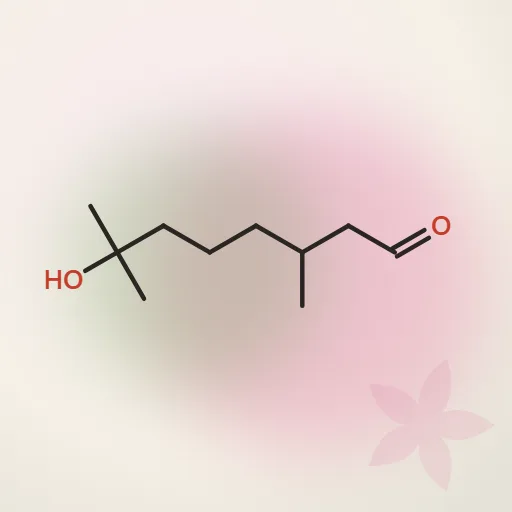
In short
Hydroxycitronellal is a classic lily-of-the-valley material, made from citronellal. It gives a soft, sweet muguet note and was a cornerstone of floral perfumery for most of the twentieth century.
What Hydroxycitronellal smells like
Hydroxycitronellal is the classic lily-of-the-valley material. Arctander, as quoted by suppliers, describes a sweet-floral odour, at first delicate and refreshingly mild but often growing in strength after short study, with mild, light floral notes resembling lily of the valley. Trade descriptions add fresh floral, delicate muguet and linden blossom, and its taste is sweet, floral and green with a fruity melon note. A patent on related materials notes that it comes remarkably close to the odour of lily of the valley.
- Leading note
- Soft lily of the valley
- Clear facets
- Linden blossom
- Supporting facets
- Sweet
- Faint facets
- Fresh green, melon
- Character
- Soft, sweet, mild, tenacious
What makes Hydroxycitronellal distinctive
Gentleness that grows. It opens delicate and mild, then strengthens on the blotter, and it is the softest, most linden-like of the muguet materials — the reference the newer ones are measured against.
Concentration and dilution
Arctander notes it seems mild at first and grows in strength after short study, and that its diffusion increases markedly when blended with more volatile materials.
How Hydroxycitronellal is used
Long a near-essential in muguet accords and used in peony, lily, sweet pea, narcissus and linden-blossom compositions. It is one of the 26 fragrance allergens individually named in EU cosmetics law and is restricted by IFRA.
Typical role: backbone (used in large proportions as a structural material of an accord).
How Hydroxycitronellal differs from similar materials
- Lilyflore
- Reference data place Lilyflore between hydroxycitronellal and the muguet aldehydes; it is more watery and powdery, and more stable, where hydroxycitronellal is softer and more linden-like.
- Mayol
- Mayol is fresher, cleaner and more transparent, with magnolia and slightly spicy-aldehydic touches; hydroxycitronellal is sweeter and more linden-like.
- Florol
- Florol is a fresh, natural muguet with an ozonic and slightly rosy side; hydroxycitronellal is sweeter and softer, with linden.
- Majantol
- Majantol is fresh and intensely floral with a slightly green-fruity top; hydroxycitronellal is milder at first, sweeter and more linden-like.
- Nympheal
- Nympheal is far more powerful and diffusive, watery and opulent; both share a linden-blossom facet, but hydroxycitronellal is the softer, sweeter one.
Each difference compares the published descriptions of the two materials. Smell varies with grade, supplier and dilution; compare them side by side on blotters before substituting one for another.
Formulation considerations
A declarable allergen covered by an IFRA Standard. Reacts with anthranilates and other amines.
Identity and classification
- Type
- Aroma chemical
- Origin
- Synthetic
- Odour family
- Floral / Green
- Note position
- Heart note
- Physical form at room temperature
- Liquid
- CAS number
- 107-75-5
- Molecular formula
- C10H20O2
- Molecular weight
- 172.26 g/mol
- IUPAC name
- 7-hydroxy-3,7-dimethyloctanal
The CAS number, formula and molecular weight are taken from PubChem compound 7888, whose own record lists this CAS number; checked 19 October 2026.
Safety and compliance
The IFRA Standards Library lists a Standard covering Hydroxycitronellal:
- "Hydroxycitronellal" — Restriction, 51st Amendment, published 2023-06
Limits differ by product category and are set out in the Standard itself; this page does not reproduce them. The list above reflects the library as read on 19 October 2026.
Hydroxycitronellal is one of the 26 fragrance allergens listed individually in Annex III of the EU Cosmetics Regulation (label name: Hydroxycitronellal), which must be named on cosmetic labels above 0.001% in leave-on and 0.01% in rinse-off products. Regulation (EU) 2023/1545 extended the list; see the fragrance allergens list.
Hazard classification of the neat substance, as PubChem summarises it, read 26 October 2026. Companies notifying the ECHA C&L Inventory report it as not meeting the GHS hazard criteria (1 of 2,046 reports). Unless it is harmonised, this is the notifiers' own classification, not a binding one.
This page is general information, not a safety assessment or a specification. Confirm identity, composition, IFRA status and allergen content from your supplier's documents for the lot you hold.
Materials it works with
-

 Florol
Aroma chemical · Floral / Green — muguet, fresh, floral, clean
-

 Mayol
Aroma chemical · Floral / Green — muguet, fresh, clean, floral
-

 Cyclamen Aldehyde
Aroma chemical · Floral / Green — floral, green, watery, fresh
-

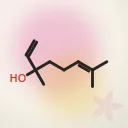 Linalool
Aroma chemical · Floral / Citrus — floral, fresh, woody, citrus
-

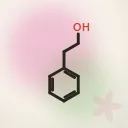 Phenylethyl Alcohol
Aroma chemical · Floral / Green — rose, honeyed, soft, floral
Hydroxycitronellal is also suggested as a partner on the pages for Acetaldehyde Ethyl Linalyl Acetal, Aquaflora, Coranol, Dupical, Florhydral and Hivernal Neo.
Used in formulas and accords
Used in 23 published formulas
Hydroxycitronellal is an ingredient in 5 perfume formulas, 16 accords and 2 bases in the Formula & Accord Library.
Community formulas
RUŌOD House Originals
Original compositions by RUŌOD House.
Further reading
Questions about Hydroxycitronellal
Is Hydroxycitronellal natural or synthetic?
Hydroxycitronellal is synthetic — it is made by chemical synthesis.
What is the CAS number of Hydroxycitronellal?
107-75-5. It was checked against PubChem on 19 October 2026.
Which published formulas use Hydroxycitronellal?
Hydroxycitronellal is used in 23 published formulas in the RUŌOD Lab Formula & Accord Library, including Bell Glass, Carnation Accord and Fig Accord. Each is listed with a link under "Used in formulas and accords" on this page.
Is Hydroxycitronellal covered by an IFRA Standard?
Yes. The IFRA Standards Library lists a Standard covering it: "Hydroxycitronellal" — Restriction, 51st Amendment. The limits depend on the product category; read the Standard itself before formulating.
Sources
- PubChem — compound 7888, checked 19 October 2026.
- PubChem — GHS classification (the ECHA C&L Inventory notifications and any harmonised EU entry), read 26 October 2026.
- IFRA — Standards Library, read 19 October 2026.
- EUR-Lex — Regulation (EC) No 1223/2009, Annex III.
- The Good Scents Company — hydroxycitronellal — odour database.
- Scentspiracy — Hydroxycitronellal (quoting Arctander) — distributor's description.
- Fraterworks — hydroxycitronellal — distributor's description.
- Olfactory profile: the RUŌOD Lab team's synthesis of the published descriptions above, reviewed 20 October 2026. Evidence: several independent published descriptions, which agree. Classification and the short description: revision 1. Descriptions of odour are judgement, not measurement.