

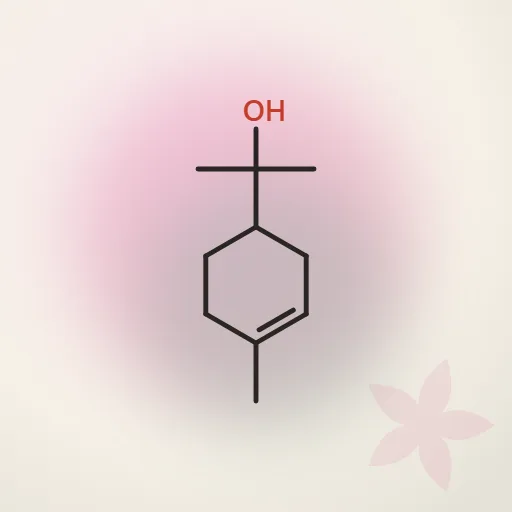
In short
alpha-Terpineol is a terpene alcohol with a lilac-like floral note, found in pine and many essential oils. It is an inexpensive, stable floral material.
What alpha-Terpineol smells like
Alpha-terpineol pairs a soft lilac floral with a fresh, pine-like terpenic side. Arctander, quoted by The Good Scents Company, calls it one of the most commonly used of all perfume chemicals, a basic component of lilac perfumes and a major component of many pine fragrances. Firmenich describes its grade as delicately floral and sweet, of the lilac type. Reference descriptors run from pine, terpenic and lilac to citrus, woody and resinous; both mirror-image forms smell of lilac, the laevo form more terpenic.
- Leading note
- Soft lilac
- Clear facets
- Pine
- Faint facets
- Citrus, woody, soapy
- Character
- Soft, sweet, fresh, clean
What makes alpha-Terpineol distinctive
It is lilac and pine at once — the reason it serves both as the basis of lilac accords and as a staple of pine fragrances, a double life few floral materials share.
How alpha-Terpineol is used
Used very widely: as a basic component of lilac perfumes, in pine and fresh fragrances, and as a cheap, stable floral blender in soap and household products.
Typical role: blender (smooths the joins between other materials).
How alpha-Terpineol differs from similar materials
- Terpinyl Acetate
- Terpinyl acetate, its ester, is a sweeter, herbaceous bergamot-lavender; alpha-terpineol is lilac and pine.
Each difference compares the published descriptions of the two materials. Smell varies with grade, supplier and dilution; compare them side by side on blotters before substituting one for another.
Formulation considerations
Stable in alkaline bases such as soap.
Identity and classification
- Type
- Aroma chemical
- Origin
- Occurs in nature
- Odour family
- Floral / Aromatic
- Note position
- Heart note
- Physical form at room temperature
- Liquid
- CAS number
- 98-55-5
- Molecular formula
- C10H18O
- Molecular weight
- 154.25 g/mol
- IUPAC name
- 2-(4-methylcyclohex-3-en-1-yl)propan-2-ol
The CAS number, formula and molecular weight are taken from PubChem compound 17100, whose own record lists this CAS number; checked 19 October 2026.
Safety and compliance
Hazard classification of the neat substance, as PubChem summarises it, read 26 October 2026. Companies notifying the ECHA C&L Inventory classify it (2,747 reports): H315 causes skin irritation (98.9% of reports); H319 causes serious eye irritation (81.8% of reports). 29 of the reports find it does not meet the hazard criteria. Unless it is harmonised, this is the notifiers' own classification, not a binding one.
This page is general information, not a safety assessment or a specification. Confirm identity, composition, IFRA status and allergen content from your supplier's documents for the lot you hold.
Materials it works with
-

 Heliotropin
Aroma chemical · Powdery / Gourmand — powdery, almond, vanilla, floral
-

 Phenylacetaldehyde
Aroma chemical · Green / Floral — green, honeyed, hyacinth, floral
-

 Anisaldehyde
Aroma chemical · Powdery / Floral — anisic, hawthorn, floral, sweet
alpha-Terpineol is also suggested as a partner on the pages for Anisyl Alcohol, Dimethyl Benzyl Carbinol, Hydratropic Aldehyde, Phenylethyl Dimethyl Carbinol, Terpinen-4-ol and Trifernal.
Used in formulas and accords
Used in 14 published formulas
alpha-Terpineol is an ingredient in 10 accords and 4 bases in the Formula & Accord Library.
Further reading
Questions about alpha-Terpineol
Is alpha-Terpineol natural or synthetic?
The molecule occurs in nature. Commercial alpha-Terpineol may be made by synthesis or obtained from natural sources, so check the supplier's specification if the distinction matters to you.
What is the CAS number of alpha-Terpineol?
98-55-5. It was checked against PubChem on 19 October 2026.
Which published formulas use alpha-Terpineol?
alpha-Terpineol is used in 14 published formulas in the RUŌOD Lab Formula & Accord Library, including Cannabis Base, Carnation Accord and Cranberry Base. Each is listed with a link under "Used in formulas and accords" on this page.
Sources
- PubChem — compound 17100, checked 19 October 2026.
- PubChem — GHS classification (the ECHA C&L Inventory notifications and any harmonised EU entry), read 26 October 2026.
- The Good Scents Company — alpha-terpineol (quoting Arctander and Firmenich) — odour database.
- Wikipedia — Terpineol — published perfumery reference.
- Scentspiracy — Terpineol — distributor's description.
- Olfactory profile: the RUŌOD Lab team's synthesis of the published descriptions above, reviewed 20 October 2026. Evidence: several independent published descriptions, which agree. Classification and the short description: revision 1. Descriptions of odour are judgement, not measurement.