
In short
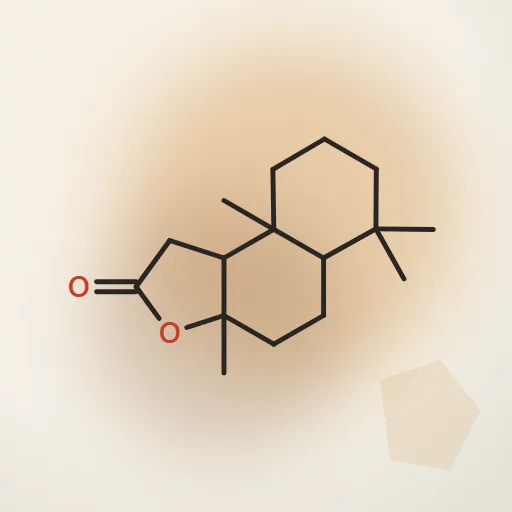
Sclareolide is a lactone derived from sclareol. It has a warm, woody-ambery odour with tobacco and mossy notes.
What Sclareolide smells like
Sclareolide is made from sclareol and used mainly as a precursor to Ambroxan. The Good Scents Company gives only a woody odour type of medium strength; Parchem lists intense, aromatic, woody and moss-like with cedar and tobacco nuances; Sigma-Aldrich notes its use for an amber-like odour; ChemicalBook calls it musky and woody. No source found calls it faint.
- Leading note
- Woody amber-tobacco
- Supporting facets
- Tobacco, mossy
- Faint facets
- Musky
- Character
- Warm, dry, tenacious
What makes Sclareolide distinctive
The step between sclareol and Ambroxan: a woody, mossy amber with tobacco.
Where the descriptions disagree: The record's descriptors call it faint; the sources found describe medium to intense strength.
How Sclareolide is used
Used as an amber-woody fixative in tobacco, amber and woody compositions, and as a precursor to Ambroxan.
Typical role: fixative (slow to evaporate; helps a blend last and holds lighter notes).
How Sclareolide differs from similar materials
- Sclareol
- Sclareol is nearly odourless or a faint amber-tobacco; sclareolide is described as stronger, woody and mossy.
Each difference compares the published descriptions of the two materials. Smell varies with grade, supplier and dilution; compare them side by side on blotters before substituting one for another.
Formulation considerations
A solid; dissolve before use.
Identity and classification
- Type
- Aroma chemical
- Origin
- Semi-synthetic
- Odour family
- Amber / Woody
- Note position
- Base note
- Physical form at room temperature
- Solid
- CAS number
- 564-20-5
- Molecular formula
- C16H26O2
- Molecular weight
- 250.38 g/mol
- IUPAC name
- (3aR,5aS,9aS,9bR)-3a,6,6,9a-tetramethyl-1,4,5,5a,7,8,9,9b-octahydrobenzo[e][1]benzofuran-2-one
The CAS number, formula and molecular weight are taken from PubChem compound 929262, whose own record lists this CAS number; checked 19 October 2026.
Safety and compliance
Hazard classification of the neat substance, as PubChem summarises it, read 26 October 2026. Companies notifying the ECHA C&L Inventory report it as not meeting the GHS hazard criteria (1,553 of 1,583 reports). Unless it is harmonised, this is the notifiers' own classification, not a binding one.
This page is general information, not a safety assessment or a specification. Confirm identity, composition, IFRA status and allergen content from your supplier's documents for the lot you hold.
Materials it works with
-
 Sclareol
Natural isolate · Amber / Woody — amber, balsamic, faint, tobacco
-

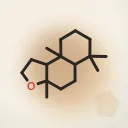 Ambroxan
Aroma chemical · Amber / Woody — amber, ambergris, woody, mineral
-
 Tonka Bean Absolute
Absolute · Gourmand / Powdery — coumarinic, hay, almond, sweet
Sclareolide is also suggested as a partner on the pages for Ambrinol.
Used in formulas and accords
Used in 12 published formulas
Sclareolide is an ingredient in 11 perfume formulas and 1 accord in the Formula & Accord Library.
RUŌOD House Originals
Original compositions by RUŌOD House.
Further reading
Questions about Sclareolide
Is Sclareolide natural or synthetic?
Sclareolide is semi-synthetic: it is made by chemically modifying a natural raw material.
What is the CAS number of Sclareolide?
564-20-5. It was checked against PubChem on 19 October 2026.
Which published formulas use Sclareolide?
Sclareolide is used in 12 published formulas in the RUŌOD Lab Formula & Accord Library, including Apple Cellar, Cured Leaf and Ember Tea House. Each is listed with a link under "Used in formulas and accords" on this page.
Sources
- PubChem — compound 929262, checked 19 October 2026.
- PubChem — GHS classification (the ECHA C&L Inventory notifications and any harmonised EU entry), read 26 October 2026.
- The Good Scents Company — sclareolide — odour database.
- Parchem — sclareolide — distributor's description.
- Sigma-Aldrich — sclareolide — manufacturer's description.
- Olfactory profile: the RUŌOD Lab team's synthesis of the published descriptions above, reviewed 26 October 2026. Evidence: more than one published description. Classification and the short description: revision 2. Descriptions of odour are judgement, not measurement.