
In short
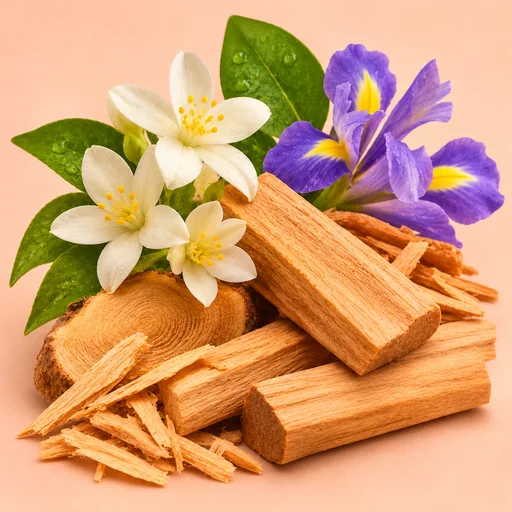
Sandela is a Givaudan sandalwood aroma chemical, an isobornyl cyclohexanol. It gives a classical, balsamic sandalwood note that is light in strength but very long-lasting, used in all fragrance types.
What Sandela smells like
Givaudan describes Sandela as a classical sandalwood note that can be used in all fragrance types, woody, sandalwood and balsamic, lasting three weeks on a blotter. Fraterworks calls it perhaps the most important sandalwood aroma chemical: very light in odour strength but extremely long-lasting, creamy, nutty and sweet. A glossary evaluation finds it dry, clean and balsamic, a flat, linear woodiness with a faint cashew nut and none of the milky depth of natural sandalwood, reading as clean wood more than sandalwood. Wikipedia notes its structure is close to the santalols.
- Leading note
- Dry balsamic sandalwood
- Supporting facets
- Creamy, nutty, balsamic
- Faint facets
- Cashew
- Character
- Light, linear, tenacious, clean
What makes Sandela distinctive
A sandalwood of persistence rather than power: faint at first, it stays for weeks and carries a blend's base.
Where the descriptions disagree: Fraterworks finds it creamy and sweet; the glossary finds it dry and flat, without sandalwood's creaminess. The difference may lie in strength and time on the strip.
How Sandela is used
Fraterworks uses it in overdose as the main sandalwood chemical or in very small amounts as a fixative; Givaudan in all fragrance types.
Typical role: fixative (slow to evaporate; helps a blend last and holds lighter notes); backbone (used in large proportions as a structural material of an accord).
How Sandela differs from similar materials
- Polysantol
- A glossary finds Sandela less sweet and less creamy than Polysantol, a flatter, drier, more linear wood. (compared directly by a cited source)
- Javanol
- A glossary finds Sandela far less potent than Javanol, which is the powerful, rosy-milky sandalwood; Sandela is quiet, dry and long-lasting. (compared directly by a cited source)
- Osyrol
- Osyrol is a lighter, sweeter sandalwood with floral nuances, used as a canvas; Sandela is drier, more balsamic and more tenacious.
An asterisk marks a difference that a cited source states directly. The others compare the published descriptions of each material. Smell varies with grade, supplier and dilution; compare them side by side on blotters before substituting one for another.
Formulation considerations
Weak at first smell; some people need time to perceive it. Very viscous.
Identity and classification
- Type
- Aroma chemical
- Origin
- Synthetic
- Odour family
- Woody / Resinous
- Note position
- Base note
- Physical form at room temperature
- Viscous liquid. Very viscous: Givaudan sells it as Sandela 85 IPM, with 15% isopropyl myristate added for handling.
- Also known as
- Isobornyl cyclohexanol
- CAS number
- 3407-42-9
- Molecular formula
- C16H28O
- Molecular weight
- 236.39 g/mol
- IUPAC name
- 3-(5,5,6-trimethyl-2-bicyclo[2.2.1]heptanyl)cyclohexan-1-ol
The CAS number, formula and molecular weight are taken from PubChem compound 103005, whose own record lists this CAS number; checked 7 November 2026.
Safety and compliance
Hazard classification of the neat substance, as PubChem summarises it, read 7 November 2026. Companies notifying the ECHA C&L Inventory classify it (1,483 reports): H315 causes skin irritation (85.4% of reports); H411 toxic to aquatic life with long lasting effects (71.9% of reports); H319 causes serious eye irritation (35.7% of reports); H412 harmful to aquatic life with long lasting effects (10.6% of reports). Unless it is harmonised, this is the notifiers' own classification, not a binding one.
This page is general information, not a safety assessment or a specification. Confirm identity, composition, IFRA status and allergen content from your supplier's documents for the lot you hold.
Materials it works with
-
 Sandalore
Aroma chemical · Woody / Musky — sandalwood, warm, soft, woody
-
 Polysantol
Aroma chemical · Woody / Musky — sandalwood, creamy, milky, woody
-
 Javanol
Aroma chemical · Woody / Floral — sandalwood, creamy, rosy, milky
-
 Sandalwood Oil (Santalum album)
Essential oil · Woody / Musky — woody, creamy, milky, sweet
-
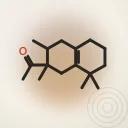 Iso E Super
Aroma chemical · Woody / Amber — woody, velvety, amber, cedar
-
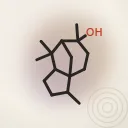 Cedrol
Natural isolate · Woody / Musky — woody, cedar, faint, dry
Sandela is also suggested as a partner on the pages for Osyrol.
Used in formulas and accords
Not currently used in any published formula.
The Formula & Accord Library lists Sandela here as soon as a published formula, accord or base uses it.
Further reading
Questions about Sandela
Is Sandela natural or synthetic?
Sandela is synthetic — it is made by chemical synthesis.
What is the CAS number of Sandela?
3407-42-9. It was checked against PubChem on 7 November 2026.
Sources
- PubChem — compound 103005, checked 7 November 2026.
- PubChem — GHS classification (the ECHA C&L Inventory notifications and any harmonised EU entry), read 7 November 2026.
- Givaudan — Sandela 85 IPM — manufacturer's description.
- Fraterworks — Sandela 85 IPM — distributor's description.
- Premiere Peau — Sandela — published perfumery reference.
- Wikipedia — Isobornyl cyclohexanol — published perfumery reference.
- PubChem — isobornyl cyclohexanol (CID 103005) — odour database.
- Olfactory profile: the RUŌOD Lab team's synthesis of the published descriptions above, reviewed 7 November 2026. Evidence: several independent published descriptions, which agree. Classification and the short description: revision 1. Descriptions of odour are judgement, not measurement.