

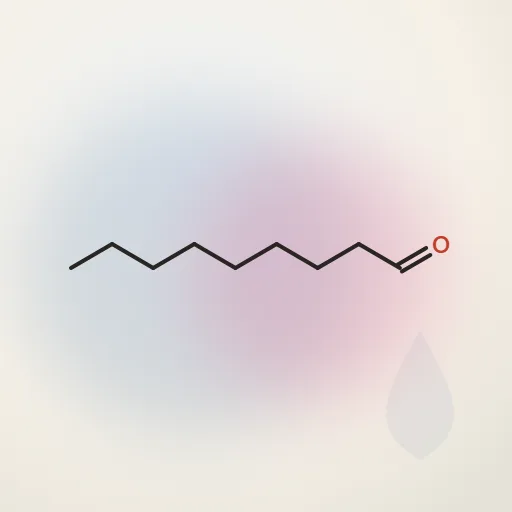
In short
Aldehyde C-9, nonanal, is an aliphatic aldehyde with a waxy, rosy-citrus odour. It occurs in rose and citrus oils and adds a fresh, slightly fatty sparkle in traces.
What Aldehyde C-9 (Nonanal) smells like
Nonanal (aldehyde C-9) is a waxy, aldehydic material whose citrus side turns towards rose. Firmenich describes a classical aldehyde note — waxy, citrus, floral and green; Givaudan aldehydic, fatty, rosy and citrus; Bedoukian strong, floral and mostly orange. Parchem adds a slightly green lemon-peel nuance and a cucumber-like fattiness. It occurs in rose and citrus oils and is used to improve rose-like odours.
- Leading note
- Waxy aldehydic
- Clear facets
- Rose, orange and citrus peel
- Supporting facets
- Fatty
- Faint facets
- Green, cucumber
- Character
- Waxy, fatty, fresh, soft
What makes Aldehyde C-9 (Nonanal) distinctive
The rose. Of the straight-chain aldehydes it is the one whose waxiness reads floral and rosy as well as citrus — the reason it is used in rose compositions, not only in citrus ones.
How Aldehyde C-9 (Nonanal) is used
Used at low levels for aldehydic lift in floral and citrus compositions, and particularly to make rose notes more natural.
Typical role: modifier (used in small amounts to change the character of a blend).
How Aldehyde C-9 (Nonanal) differs from similar materials
- Aldehyde C-8 (Octanal)
- Octanal is sharper and more pungent, fatty orange peel; nonanal is waxier and rosier.
- Aldehyde C-10 (Decanal)
- Decanal is the powerful orange-peel aldehyde; nonanal shares its waxiness but tilts towards rose rather than orange.
- Rosalva
- Rosalva is an alcohol, dewier and more specifically rose-petal; nonanal is a waxy aldehyde leaning rose and orange.
- 1-Nonanol
- 1-Nonanol (alcohol C-9), its alcohol, is rose-citrus and floral without the aldehydic, waxy edge.
Each difference compares the published descriptions of the two materials. Smell varies with grade, supplier and dilution; compare them side by side on blotters before substituting one for another.
Formulation considerations
Strong; dose from dilution. Oxidises over time.
Identity and classification
- Type
- Aroma chemical
- Origin
- Occurs in nature
- Odour family
- Aldehydic / Floral
- Note position
- Top note
- Physical form at room temperature
- Liquid
- Also known as
- Nonanal, Pelargonaldehyde
- CAS number
- 124-19-6
- Molecular formula
- C9H18O
- Molecular weight
- 142.24 g/mol
- IUPAC name
- nonanal
The CAS number, formula and molecular weight are taken from PubChem compound 31289, whose own record lists this CAS number; checked 19 October 2026.
Safety and compliance
Hazard classification of the neat substance, as PubChem summarises it, read 26 October 2026. Companies notifying the ECHA C&L Inventory classify it (1,956 reports): H412 harmful to aquatic life with long lasting effects (92.9% of reports); H315 causes skin irritation (19.3% of reports); H319 causes serious eye irritation (18.5% of reports). 83 of the reports find it does not meet the hazard criteria. Unless it is harmonised, this is the notifiers' own classification, not a binding one.
This page is general information, not a safety assessment or a specification. Confirm identity, composition, IFRA status and allergen content from your supplier's documents for the lot you hold.
Materials it works with
-

 Aldehyde C-10 (Decanal)
Aroma chemical · Aldehydic / Citrus — aldehydic, waxy, orange peel, fatty
-

 Rose Oil (Rosa damascena)
Essential oil · Floral / Fruity — rose, honeyed, spicy, fresh
-

 Phenylethyl Alcohol
Aroma chemical · Floral / Green — rose, honeyed, soft, floral
Aldehyde C-9 (Nonanal) is also suggested as a partner on the pages for 1-Nonanol, Aldehyde C-7 (Heptanal) and Aldehyde C-8 (Octanal).
Used in formulas and accords
Used in 8 published formulas
Aldehyde C-9 (Nonanal) is an ingredient in 4 perfume formulas and 4 accords in the Formula & Accord Library.
Community formulas
RUŌOD House Originals
Original compositions by RUŌOD House.
Further reading
Questions about Aldehyde C-9 (Nonanal)
Is Aldehyde C-9 (Nonanal) natural or synthetic?
The molecule occurs in nature. Commercial Aldehyde C-9 (Nonanal) may be made by synthesis or obtained from natural sources, so check the supplier's specification if the distinction matters to you.
What is the CAS number of Aldehyde C-9 (Nonanal)?
124-19-6. It was checked against PubChem on 19 October 2026.
Which published formulas use Aldehyde C-9 (Nonanal)?
Aldehyde C-9 (Nonanal) is used in 8 published formulas in the RUŌOD Lab Formula & Accord Library, including Champagne Static, Glass Rose Accord and Maple Fog. Each is listed with a link under "Used in formulas and accords" on this page.
Sources
- PubChem — compound 31289, checked 19 October 2026.
- PubChem — GHS classification (the ECHA C&L Inventory notifications and any harmonised EU entry), read 26 October 2026.
- The Good Scents Company — nonanal (with Firmenich, Givaudan and Bedoukian descriptions) — odour database.
- Parchem — nonanal specification — distributor's description.
- ChemicalBook — nonanal (CAS 124-19-6) — odour database.
- Olfactory profile: the RUŌOD Lab team's synthesis of the published descriptions above, reviewed 24 October 2026. Evidence: several independent published descriptions, which agree. Classification and the short description: revision 1. Descriptions of odour are judgement, not measurement.