
In short
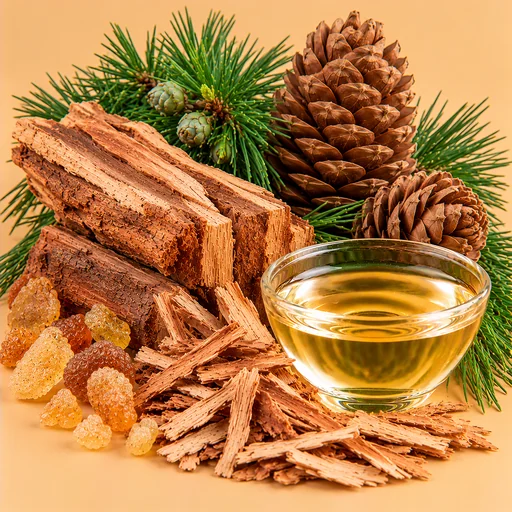
Himalayan cedarwood oil is distilled from the wood of Cedrus deodara. It is a true cedar oil, close in character to Atlas cedarwood, with a sweet, balsamic woodiness.
What Cedarwood Oil (Himalayan) smells like
Himalayan cedarwood (Cedrus deodara) oil has a rich, sweet-woody, almost balsamic aroma reminiscent of Atlas cedarwood, but, as Holmes is cited, lacks Atlas's pronounced sweetness and has a stronger dry-woody note. Eden Botanicals describes it as dry, woody, warm and balsamic, with a slightly crude, camphoraceous top and a delicately sweet-woody drydown.
- Leading note
- Dry balsamic cedar
- Supporting facets
- Sweet woody
- Faint facets
- Camphoraceous
- Character
- Dry, warm, smooth
What makes Cedarwood Oil (Himalayan) distinctive
Atlas cedar's drier sibling: the same balsamic wood with less sweetness.
How Cedarwood Oil (Himalayan) is used
Used as a woody base in woody, oriental and masculine compositions.
Typical role: backbone (used in large proportions as a structural material of an accord); fixative (slow to evaporate; helps a blend last and holds lighter notes).
How Cedarwood Oil (Himalayan) differs from similar materials
- Cedarwood Oil (Atlas)
- Atlas is sweeter; Himalayan is drier, with a stronger dry-woody note. (compared directly by a cited source)
An asterisk marks a difference that a cited source states directly. The others compare the published descriptions of each material. Smell varies with grade, supplier and dilution; compare them side by side on blotters before substituting one for another.
Identity and classification
- Type
- Essential oil
- Origin
- Natural
- Odour family
- Woody
- Note position
- Base note
- Physical form at room temperature
- Viscous liquid
- Also known as
- Deodar cedarwood oil
- Botanical source
- Cedrus deodara
No CAS number is shown: suppliers use different identifiers for this material, and none could be confirmed as its own.
Safety and compliance
Amrita's safety data sheet for Himalayan cedar (Cedrus deodara) oil gives H226, H304 (aspiration hazard), H315 and H319; other suppliers' sheets pair H304 with aquatic statements instead, and they use different CAS numbers. H304 is the one statement every sheet found carries.
This page is general information, not a safety assessment or a specification. Confirm identity, composition, IFRA status and allergen content from your supplier's documents for the lot you hold.
Materials it works with
-
 Cedarwood Oil (Atlas)
Essential oil · Woody / Amber — woody, warm, balsamic, sweet
-
 Cedarwood Oil (Virginia)
Essential oil · Woody / Aromatic — woody, dry, pencil shavings, clean
-

 Vetiver Oil
Essential oil · Woody / Green — earthy, smoky, woody, rooty
-

 Labdanum Absolute
Absolute · Amber / Leather — amber, balsamic, leathery, animalic
Used in formulas and accords
Used in 13 published formulas
Cedarwood Oil (Himalayan) is an ingredient in 13 perfume formulas in the Formula & Accord Library.
RUŌOD House Originals
Original compositions by RUŌOD House.
Further reading
Questions about Cedarwood Oil (Himalayan)
Is Cedarwood Oil (Himalayan) natural or synthetic?
Cedarwood Oil (Himalayan) is natural. It is a volatile oil obtained from plant material by steam distillation or, for citrus peels, by cold expression.
Which published formulas use Cedarwood Oil (Himalayan)?
Cedarwood Oil (Himalayan) is used in 13 published formulas in the RUŌOD Lab Formula & Accord Library, including Anise Ink, Birch Ghost and Cherry Lacquer. Each is listed with a link under "Used in formulas and accords" on this page.
Sources
- Amrita — Cedar Himalayan (Organic) safety data sheet — safety information, read 26 October 2026.
- Eden Botanicals — Cedarwood, Himalayan — distributor's description.
- Salvatore Battaglia — Atlas cedarwood monograph (citing Holmes) — published perfumery reference.
- Olfactory profile: the RUŌOD Lab team's synthesis of the published descriptions above, reviewed 21 October 2026. Evidence: more than one published description. Classification and the short description: revision 1. Descriptions of odour are judgement, not measurement.