

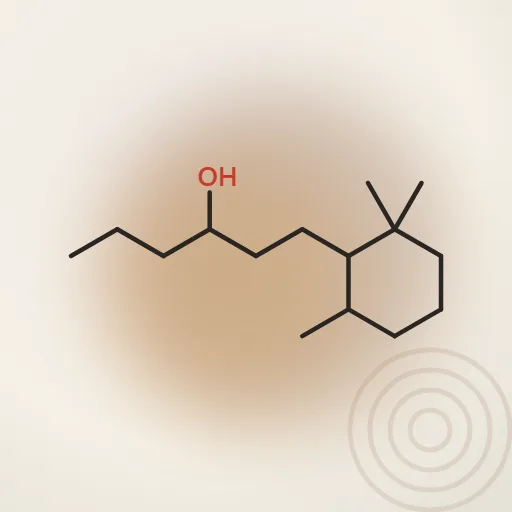
In short
Timberol (also sold as Norlimbanol) is a synthetic woody-amber material with a dry, powerful, animalic woody note.
What Timberol smells like
Timberol (Symrise) is highly diffusive and powdery-woody with notes of ambergris, in Symrise's data sheet; The Good Scents Company lists dry, sawdust, woody, powdery, amber and sandalwood from a 1987 evaluation of a Dragoco sample; Scentspiracy dry, sharp, woody-ambery with cedarwood facets, clean, substantive and very strong. Timberol is the high-cis form; its trans-rich counterpart, Norlimbanol (Firmenich), is reported stronger and more amber-like.
- Leading note
- Dry powdery wood
- Supporting facets
- Ambergris, sawdust
- Faint facets
- Cedarwood, sandalwood
- Character
- Dry, diffusive, powerful
What makes Timberol distinctive
Sawdust and ambergris: an intensely dry, powdery wood with great diffusion.
Where the descriptions disagree: The record lists Norlimbanol as another name; one source describes Norlimbanol as the distinct trans-rich form, stronger and more amber-like.
How Timberol is used
Used for dry woody-amber diffusion in woody, masculine and functional compositions.
Typical role: modifier (used in small amounts to change the character of a blend); fixative (slow to evaporate; helps a blend last and holds lighter notes).
How Timberol differs from similar materials
- Karanal
- Karanal is a radiant woody amber with a faint watermelon-like fruitiness; Timberol is drier and more powdery, sawdust-like.
- Ambrocenide
- Ambrocenide is a sharper, mineral ambergris with smoky facets; Timberol is the drier, powdery sawdust wood.
- Mahagonate
- Mahagonate is dry sawdust with herbal patchouli and laurel; Timberol adds ambergris and powder.
Each difference compares the published descriptions of the two materials. Smell varies with grade, supplier and dilution; compare them side by side on blotters before substituting one for another.
Formulation considerations
Very strong; covered by an IFRA Standard.
Identity and classification
- Type
- Aroma chemical
- Origin
- Synthetic
- Odour family
- Woody / Amber
- Note position
- Base note
- Physical form at room temperature
- Liquid
- Also known as
- Norlimbanol
- CAS number
- 70788-30-6
- Molecular formula
- C15H30O
- Molecular weight
- 226.4 g/mol
- IUPAC name
- 1-(2,2,6-trimethylcyclohexyl)hexan-3-ol
The CAS number, formula and molecular weight are taken from PubChem compound 116699, whose own record lists this CAS number; checked 19 October 2026.
Safety and compliance
The IFRA Standards Library lists a Standard covering Timberol:
- "1-(2,2,6-Trimethylcyclohexyl)-3-hexanol" — Restriction, 51st Amendment, published 2023-06
Limits differ by product category and are set out in the Standard itself; this page does not reproduce them. The list above reflects the library as read on 19 October 2026.
Hazard classification of the neat substance, as PubChem summarises it, read 26 October 2026. Companies notifying the ECHA C&L Inventory classify it (1,690 reports): H317 may cause an allergic skin reaction (79.8% of reports); H315 causes skin irritation (20.1% of reports). 1 of the reports find it does not meet the hazard criteria. A skin sensitiser classification concerns handling the neat material and the dose in a finished product; the IFRA Standards, where they apply, set the limits. Unless it is harmonised, this is the notifiers' own classification, not a binding one.
This page is general information, not a safety assessment or a specification. Confirm identity, composition, IFRA status and allergen content from your supplier's documents for the lot you hold.
Materials it works with
-

 Iso E Super
Aroma chemical · Woody / Amber — woody, velvety, amber, cedar
-

 Ambroxan
Aroma chemical · Amber / Woody — amber, ambergris, woody, mineral
-

 Vetiver Oil
Essential oil · Woody / Green — earthy, smoky, woody, rooty
Used in formulas and accords
Used in 2 published formulas
Timberol is an ingredient in 1 perfume formula and 1 accord in the Formula & Accord Library.
Community formulas
RUŌOD House Originals
Original compositions by RUŌOD House.
Further reading
Questions about Timberol
Is Timberol natural or synthetic?
Timberol is synthetic — it is made by chemical synthesis.
What is the CAS number of Timberol?
70788-30-6. It was checked against PubChem on 19 October 2026.
Which published formulas use Timberol?
Timberol is used in 2 published formulas in the RUŌOD Lab Formula & Accord Library: Apple Cellar and Fig Accord. Each is listed with a link under "Used in formulas and accords" on this page.
Is Timberol covered by an IFRA Standard?
Yes. The IFRA Standards Library lists a Standard covering it: "1-(2,2,6-Trimethylcyclohexyl)-3-hexanol" — Restriction, 51st Amendment. The limits depend on the product category; read the Standard itself before formulating.
Sources
- PubChem — compound 116699, checked 19 October 2026.
- PubChem — GHS classification (the ECHA C&L Inventory notifications and any harmonised EU entry), read 26 October 2026.
- IFRA — Standards Library, read 19 October 2026.
- SpecialChem — Symrise Timberol — distributor's description.
- The Good Scents Company — Timberol — odour database.
- Scentspiracy — Timberol — distributor's description.
- Olfactory profile: the RUŌOD Lab team's synthesis of the published descriptions above, reviewed 26 October 2026. Evidence: more than one published description. Classification and the short description: revision 1. Descriptions of odour are judgement, not measurement.