
In short
Karanal is a Givaudan synthetic amber-woody material with a powerful, dry radiance.
What Karanal smells like
Karanal is a colourless liquid with a powerful and radiant woody-amber odour, in Scentspiracy's description; a forum perfumer adds a faint fruity, watermelon-like nuance. It projects outward with sharp clarity rather than sitting close to the skin, and lasts months on a blotter. A glossary finds it drier, less crystalline and more enveloping than Ambroxan. Since June 2015 it has been on the EU REACH Candidate List of substances of very high concern (vPvB). Perfumery suppliers report that Givaudan stopped supplying it in 2022; no statement from Givaudan itself was found.
- Leading note
- Radiant dry amber
- Clear facets
- Woody
- Faint facets
- Watermelon-like
- Character
- Powerful, radiant, tenacious
What makes Karanal distinctive
A radiant woody amber that projects rather than hugs the skin — now withdrawn by its maker.
Where the descriptions disagree: One glossary gives a different CAS number from the other sources.
How Karanal is used
Used for radiant woody-amber projection. Its EU Candidate List status, and the reported end of supply, mean its availability should be checked first.
Typical role: modifier (used in small amounts to change the character of a blend).
How Karanal differs from similar materials
- Ambroxan
- A glossary finds Karanal drier, less crystalline and more enveloping than Ambroxan. (compared directly by a cited source)
- Timberol
- Timberol is drier and more powdery, sawdust-like; Karanal is a more radiant amber with a faint fruitiness.
An asterisk marks a difference that a cited source states directly. The others compare the published descriptions of each material. Smell varies with grade, supplier and dilution; compare them side by side on blotters before substituting one for another.
Formulation considerations
Very strong; dose carefully. Since 15 June 2015 the karanal group has been on the EU REACH Candidate List of substances of very high concern, as very persistent and very bioaccumulative (vPvB). Candidate List inclusion is not in itself a ban: it brings duties to communicate about the substance along the supply chain, and a listed substance can later be moved to the Authorisation List. Check its current EU status, and its availability, before use.
Identity and classification
- Type
- Aroma chemical
- Origin
- Synthetic
- Odour family
- Amber / Woody
- Note position
- Base note
- Physical form at room temperature
- Liquid
- CAS number
- 117933-89-8
- Molecular formula
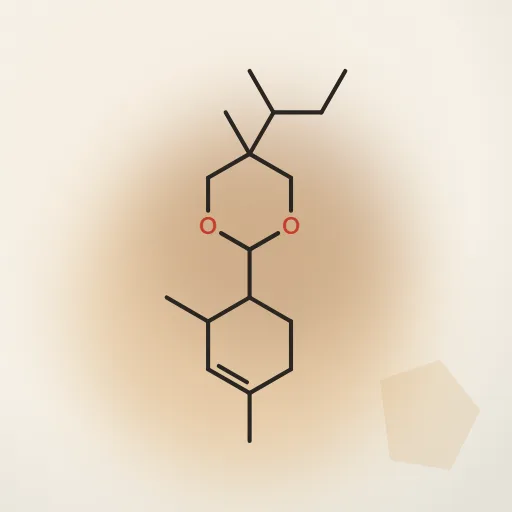
- C17H30O2
- Molecular weight
- 266.4 g/mol
- IUPAC name
- 5-butan-2-yl-2-(2,4-dimethylcyclohex-3-en-1-yl)-5-methyl-1,3-dioxane
The CAS number, formula and molecular weight are taken from PubChem compound 16070752, whose own record lists this CAS number; checked 19 October 2026.
Safety and compliance
Hazard classification of the neat substance, as PubChem summarises it, read 26 October 2026. Companies notifying the ECHA C&L Inventory classify it (163 reports): H410 very toxic to aquatic life with long lasting effects (99.4% of reports); H400 very toxic to aquatic life (96.3% of reports); H373 may causes damage to organs through prolonged or repeated exposure (75.5% of reports). Unless it is harmonised, this is the notifiers' own classification, not a binding one.
This page is general information, not a safety assessment or a specification. Confirm identity, composition, IFRA status and allergen content from your supplier's documents for the lot you hold.
Materials it works with
-
 Ambroxan
Aroma chemical · Amber / Woody — amber, ambergris, woody, mineral
-

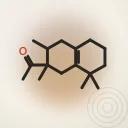 Iso E Super
Aroma chemical · Woody / Amber — woody, velvety, amber, cedar
-
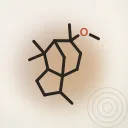 Cedramber
Aroma chemical · Woody / Amber — woody, amber, dry, cedar
Used in formulas and accords
Not currently used in any published formula.
The Formula & Accord Library lists Karanal here as soon as a published formula, accord or base uses it.
Further reading
Questions about Karanal
Is Karanal natural or synthetic?
Karanal is synthetic — it is made by chemical synthesis.
What is the CAS number of Karanal?
117933-89-8. It was checked against PubChem on 19 October 2026.
Sources
- PubChem — compound 16070752, checked 19 October 2026.
- PubChem — GHS classification (the ECHA C&L Inventory notifications and any harmonised EU entry), read 26 October 2026.
- Scentspiracy — Karanal — distributor's description.
- Scentspiracy — Goodbye Karanal — distributor's description.
- Fraterworks — Karanal — distributor's description.
- ECHA — Candidate List of substances of very high concern — regulatory record.
- Olfactory profile: the RUŌOD Lab team's synthesis of the published descriptions above, reviewed 21 October 2026. Evidence: more than one published description. Classification and the short description: revision 2. Descriptions of odour are judgement, not measurement.