

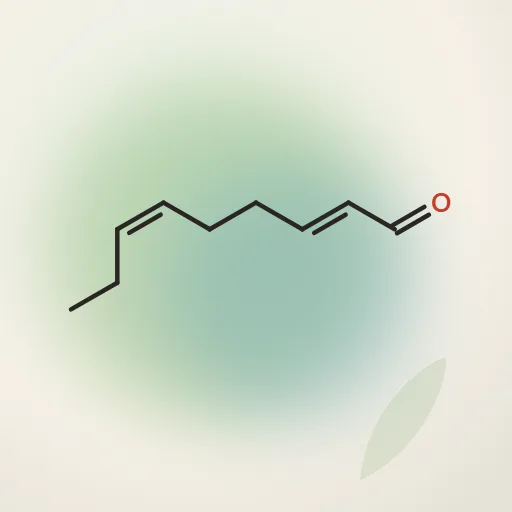
In short
2,6-Nonadienal is the molecule behind cucumber and the green note of violet leaves. It is one of the most potent green materials.
What 2,6-Nonadienal smells like
2,6-Nonadienal is the essence of cucumber and one of the keys to violet leaf: an intensely powerful, greasy green with cucumber, violet-leaf and melon notes. Bedoukian describes a powerful cucumber and violet-leaf odour in dilution with a hint of melon; Parchem lists green, cucumber, melon, fatty and vegetative. It occurs in cucumber, freshly cut watermelon and bread crust. It is so strong that it is sold diluted in dipropylene glycol, and De Hekserij describes its concentrated smell as an intense, greasy green.
- Leading note
- Cucumber
- Clear facets
- Violet leaf
- Supporting facets
- Fatty, melon
- Faint facets
- Vegetative
- Character
- Green, fatty, intense, watery
What makes 2,6-Nonadienal distinctive
It is the cucumber molecule — the aggressive, fatty-green aldehyde behind the cucumber and violet-leaf effect, harsher and leafier than its alcohol, nonadienol.
Concentration and dilution
Overwhelmingly greasy and green when concentrated; only in dilution does it read clearly as cucumber and violet leaf with a hint of melon.
How 2,6-Nonadienal is used
Used in traces as an indispensable component of violet-leaf accords and their substitutes, and for cucumber, melon and watery-green effects, alongside fruits such as melon, pear and apple and florals such as violet and linden.
Typical role: modifier (used in small amounts to change the character of a blend).
How 2,6-Nonadienal differs from similar materials
- 2,6-Nonadienol
- Givaudan describes the alcohol as fruitier and less leafy, and Fraterworks as softer and more floral than the aggressive aldehyde; it is also more stable. (compared directly by a cited source)
- Methyl Heptine Carbonate
- Methyl heptine carbonate is violet foliage first, vegetal and hay-like; nonadienal is cucumber first, fattier and more aggressive.
- Violet Leaf Absolute
- The absolute owes much of its cucumber-green to nonadienal and related compounds, but adds an earthy, waxy, metallic natural complexity.
An asterisk marks a difference that a cited source states directly. The others compare the published descriptions of each material. Smell varies with grade, supplier and dilution; compare them side by side on blotters before substituting one for another.
Formulation considerations
Extremely potent; work from 0.1% or weaker dilutions.
Identity and classification
- Type
- Aroma chemical
- Origin
- Occurs in nature
- Odour family
- Green / Aquatic
- Note position
- Top note
- Physical form at room temperature
- Liquid
- Also known as
- Cucumber aldehyde, Violet leaf aldehyde
- CAS number
- 557-48-2
- Molecular formula
- C9H14O
- Molecular weight
- 138.21 g/mol
- IUPAC name
- (2E,6Z)-nona-2,6-dienal
The CAS number, formula and molecular weight are taken from PubChem compound 643731, whose own record lists this CAS number; checked 19 October 2026.
Safety and compliance
Hazard classification of the neat substance, as PubChem summarises it, read 26 October 2026. Companies notifying the ECHA C&L Inventory classify it (1,526 reports): H317 may cause an allergic skin reaction (92.7% of reports); H315 causes skin irritation (90.5% of reports). 105 of the reports find it does not meet the hazard criteria. A skin sensitiser classification concerns handling the neat material and the dose in a finished product; the IFRA Standards, where they apply, set the limits. Unless it is harmonised, this is the notifiers' own classification, not a binding one.
This page is general information, not a safety assessment or a specification. Confirm identity, composition, IFRA status and allergen content from your supplier's documents for the lot you hold.
Materials it works with
-
 Violet Leaf Absolute
Absolute · Green / Aquatic — green, leafy, cucumber, watery
-

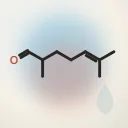 Melonal
Aroma chemical · Aquatic / Fruity — melon, watery, green, fresh
-
 Calone
Aroma chemical · Aquatic / Metallic — marine, watermelon, ozonic, watery
-

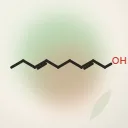 2,6-Nonadienol
Aroma chemical · Green / Fruity — cucumber, violet leaf, green, melon
2,6-Nonadienal is also suggested as a partner on the pages for cis-6-Nonenal, cis-6-Nonenol, Methyl Heptine Carbonate, Methyl Octine Carbonate and Violiff.
Used in formulas and accords
Used in 3 published formulas
2,6-Nonadienal is an ingredient in 2 perfume formulas and 1 accord in the Formula & Accord Library.
Community formulas
RUŌOD House Originals
Original compositions by RUŌOD House.
Further reading
Questions about 2,6-Nonadienal
Is 2,6-Nonadienal natural or synthetic?
The molecule occurs in nature. Commercial 2,6-Nonadienal may be made by synthesis or obtained from natural sources, so check the supplier's specification if the distinction matters to you.
What is the CAS number of 2,6-Nonadienal?
557-48-2. It was checked against PubChem on 19 October 2026.
Which published formulas use 2,6-Nonadienal?
2,6-Nonadienal is used in 3 published formulas in the RUŌOD Lab Formula & Accord Library: Lime Bruise, Pumpkin Accord and Violet Static. Each is listed with a link under "Used in formulas and accords" on this page.
Sources
- PubChem — compound 643731, checked 19 October 2026.
- PubChem — GHS classification (the ECHA C&L Inventory notifications and any harmonised EU entry), read 26 October 2026.
- The Good Scents Company — (E,Z)-2,6-nonadienal (with Bedoukian's description) — odour database.
- Parchem — (E,Z)-2,6-nonadien-1-al specification — distributor's description.
- Fraterworks — trans-2-cis-6-nonadienal — distributor's description.
- De Hekserij — 2,6-nonadien-1-al — distributor's description.
- Wikipedia — trans,cis-2,6-Nonadienal — published perfumery reference.
- Olfactory profile: the RUŌOD Lab team's synthesis of the published descriptions above, reviewed 20 October 2026. Evidence: several independent published descriptions, which agree. Classification and the short description: revision 1. Descriptions of odour are judgement, not measurement.