

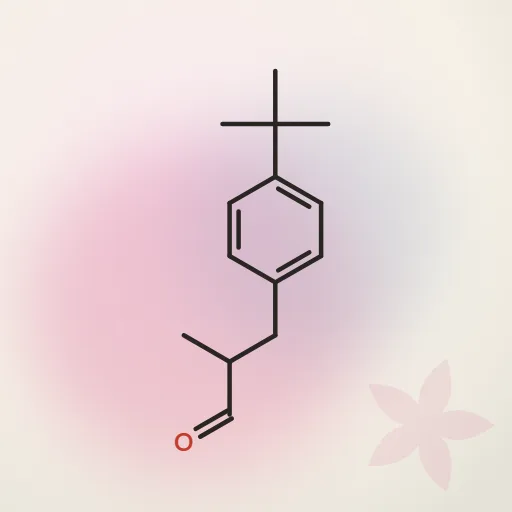
In short
Lilial (butylphenyl methylpropional) is a muguet aldehyde long used across fine and functional fragrance. It is now prohibited in cosmetic products in the EU.
What Lilial smells like
Arctander, as quoted by Scentspiracy, describes Lilial as a sweet, yet refreshing and intensely floral green odour of considerable radiance and tenacity, with notes resembling hydroxycitronellal and cyclamen aldehyde. Scentspiracy lists muguet, aldehydic, floral, sweet, soapy, clean, watery and transparent, and reports that its (R)-enantiomer smells aldehydic-chemical and its (S)-enantiomer floral-oily. Its EU and IFRA status is taken from this site's regulatory notes.
- Leading note
- Muguet
- Clear facets
- Aldehydic
- Supporting facets
- Green, watery
- Faint facets
- Soapy
- Character
- Radiant, clean
What makes Lilial distinctive
The radiant, clean muguet of late-twentieth-century fragrance, now historical in the EU.
How Lilial is used
Formerly a mainstay of muguet and clean floral accords; historic formulas name it, current EU cosmetics may not contain it.
Typical role: backbone (used in large proportions as a structural material of an accord).
How Lilial differs from similar materials
- Lyral
- Both are muguet aldehydes now prohibited in EU cosmetics; Lilial is radiant, green and aldehydic-clean, Lyral softer and more tenacious.
- Mimosal
- Mimosal was designed partly to replace Lilial in muguet accords; it adds a powdery mimosa side. (compared directly by a cited source)
An asterisk marks a difference that a cited source states directly. The others compare the published descriptions of each material. Smell varies with grade, supplier and dilution; compare them side by side on blotters before substituting one for another.
Formulation considerations
Prohibited in cosmetic products in the European Union from 1 March 2022 (Annex II, entry 1666, classified toxic for reproduction, category 1B, Regulation (EU) 2021/1902). IFRA prohibits it in lip and oral products and restricts it elsewhere (Amendment 49).
Identity and classification
- Type
- Aroma chemical
- Origin
- Synthetic
- Odour family
- Floral / Aldehydic
- Note position
- Heart note
- Physical form at room temperature
- Liquid
- Also known as
- Butylphenyl methylpropional, BMHCA, Lysmeral
- CAS number
- 80-54-6
- Molecular formula
- C14H20O
- Molecular weight
- 204.31 g/mol
- IUPAC name
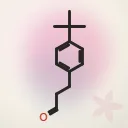
- 3-(4-tert-butylphenyl)-2-methylpropanal
The CAS number, formula and molecular weight are taken from PubChem compound 228987, whose own record lists this CAS number; checked 24 October 2026.
Safety and compliance
The IFRA Standards Library lists a Standard covering Lilial:
- "p-tert-Butyl-α-methylhydrocinnamic aldehyde (p-BMHCA)" — type not stated in the library listing, 49th Amendment, published 2020-01
Limits differ by product category and are set out in the Standard itself; this page does not reproduce them. The list above reflects the library as read on 19 October 2026.
Lilial is one of the 26 fragrance allergens listed individually in Annex III of the EU Cosmetics Regulation (label name: Butylphenyl methylpropional), which must be named on cosmetic labels above 0.001% in leave-on and 0.01% in rinse-off products. Regulation (EU) 2023/1545 extended the list; see the fragrance allergens list.
Hazard classification of the neat substance, as PubChem summarises it, read 26 October 2026. It has a harmonised EU classification (Regulation (EC) No 1272/2008, Annex VI): H360Fd may damage fertility; Suspected of damaging the unborn child. Companies notifying the ECHA C&L Inventory classify it (2,249 reports): H317 may cause an allergic skin reaction (99.6% of reports); H302 harmful if swallowed (98.7% of reports); H315 causes skin irritation (90.9% of reports); H361 suspected of damaging fertility or the unborn child (84.9% of reports); H411 toxic to aquatic life with long lasting effects (84.2% of reports); H412 harmful to aquatic life with long lasting effects (14% of reports); H360Fd may damage fertility; Suspected of damaging the unborn child (10.9% of reports). A skin sensitiser classification concerns handling the neat material and the dose in a finished product; the IFRA Standards, where they apply, set the limits. Unless it is harmonised, this is the notifiers' own classification, not a binding one.
This page is general information, not a safety assessment or a specification. Confirm identity, composition, IFRA status and allergen content from your supplier's documents for the lot you hold.
Materials it works with
-

 Hydroxycitronellal
Aroma chemical · Floral / Green — muguet, floral, soft, sweet
-

 Lilyflore
Aroma chemical · Floral / Green — muguet, floral, fresh, soft
-
 Bourgeonal
Aroma chemical · Floral / Aldehydic — muguet, aldehydic, fresh, green
Used in formulas and accords
Not currently used in any published formula.
The Formula & Accord Library lists Lilial here as soon as a published formula, accord or base uses it.
Further reading
Questions about Lilial
Is Lilial natural or synthetic?
Lilial is synthetic — it is made by chemical synthesis.
What is the CAS number of Lilial?
80-54-6. It was checked against PubChem on 24 October 2026.
Is Lilial covered by an IFRA Standard?
Yes. The IFRA Standards Library lists a Standard covering it: "p-tert-Butyl-α-methylhydrocinnamic aldehyde (p-BMHCA)" — type not stated in the library listing, 49th Amendment. The limits depend on the product category; read the Standard itself before formulating.
Sources
- PubChem — compound 228987, checked 24 October 2026.
- PubChem — GHS classification (the ECHA C&L Inventory notifications and any harmonised EU entry), read 26 October 2026.
- IFRA — Standards Library, read 19 October 2026.
- EUR-Lex — Regulation (EC) No 1223/2009, Annex III.
- Scentspiracy — Lilial — distributor's description.
- Infarmed — prohibition of butylphenyl methylpropional in cosmetics (Regulation (EU) 2021/1902) — regulatory record.
- IFRA Standard — butylphenyl methylpropional, Amendment 49 — regulatory record.
- Olfactory profile: the RUŌOD Lab team's synthesis of the published descriptions above, reviewed 24 October 2026. Evidence: more than one published description. Classification and the short description: revision 1. Descriptions of odour are judgement, not measurement.