
In short
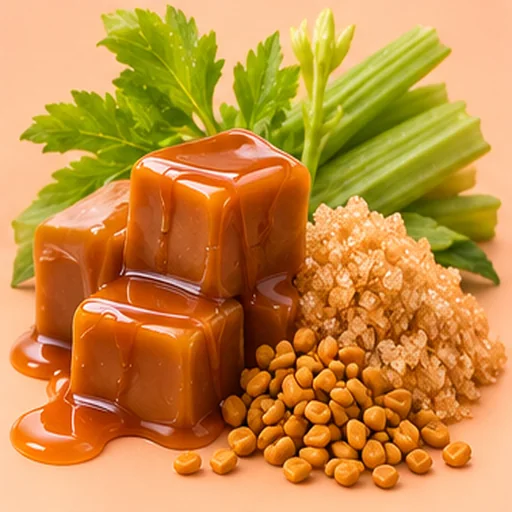
Levistamel is a Givaudan lactone with a sweet note of caramelised sugar over a green, celery, fenugreek, balsamic and aromatic background. It adds sweetness while reducing reliance on vanillin.
What Levistamel smells like
Givaudan describes Levistamel as a sweet note of caramelised sugar with a green, celery, fenugreek, balsamic and aromatic background, lasting several weeks on a blotter, able to add an interesting effect to herbal and pine fragrances and to increase sweetness while reducing vanillin. Fraterworks finds rich caramelised sugar, layered and savoury, with celery and fenugreek, a salty curry-like edge and anise-liquorice warmth developing on skin.
- Leading note
- Savoury caramel
- Clear facets
- Celery, fenugreek
- Supporting facets
- Liquorice, balsamic
- Character
- Sweet, savoury, tenacious
What makes Levistamel distinctive
Caramel with a savoury, lovage-like greenness: sweetness that reads as maple and immortelle rather than vanilla.
How Levistamel is used
Fraterworks blends it with sotolon, ethyl maltol and coumarin for deep gourmand warmth and uses its celery-fenugreek facet in lovage, immortelle and maple accords.
Typical role: modifier (used in small amounts to change the character of a blend); fixative (slow to evaporate; helps a blend last and holds lighter notes).
How Levistamel differs from similar materials
- Sotolone
- Sotolone is the intense fenugreek-maple-curry lactone; Levistamel is more caramel-sweet and balsamic, with the celery-fenugreek as a background.
Each difference compares the published descriptions of the two materials. Smell varies with grade, supplier and dilution; compare them side by side on blotters before substituting one for another.
Formulation considerations
Very tenacious, lasting weeks on a blotter.
Identity and classification
- Type
- Aroma chemical
- Origin
- Synthetic
- Odour family
- Gourmand / Aromatic
- Note position
- Base note
- Physical form at room temperature
- Solid. Givaudan and Fraterworks supply it as a 25% solution in triethyl citrate, a colourless liquid; Fraterworks states the pure material is a solid.
- Also known as
- 4,6-Dimethyl-2H-pyran-2-one, Mesitene lactone
- CAS number
- 675-09-2
- Molecular formula
- C7H8O2
- Molecular weight
- 124.14 g/mol
- IUPAC name
- 4,6-dimethylpyran-2-one
The CAS number, formula and molecular weight are taken from PubChem compound 12662, whose own record lists this CAS number; checked 7 November 2026.
Safety and compliance
Hazard classification of the neat substance, as PubChem summarises it, read 7 November 2026. Companies notifying the ECHA C&L Inventory classify it (149 reports): H302 harmful if swallowed (100% of reports); H319 causes serious eye irritation (100% of reports). Unless it is harmonised, this is the notifiers' own classification, not a binding one.
This page is general information, not a safety assessment or a specification. Confirm identity, composition, IFRA status and allergen content from your supplier's documents for the lot you hold.
Materials it works with
-

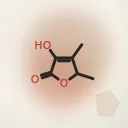 Sotolone
Aroma chemical · Gourmand / Spicy — fenugreek, maple, curry, caramel
-

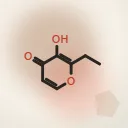 Ethyl Maltol
Aroma chemical · Gourmand / Fruity — candyfloss, caramel, sweet, jammy
-

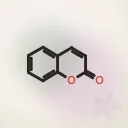 Coumarin
Aroma chemical · Powdery / Fougère — hay, sweet, almond, tobacco
-

 Lovage Root Oil
Essential oil · Aromatic / Spicy — celery, sweet, spicy, herbal
-

 Immortelle Absolute
Absolute · Aromatic / Gourmand — honey, hay, tobacco, caramel
-
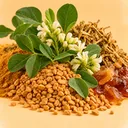
 Fenugreek Absolute
Absolute · Gourmand / Spicy — maple, curry, celery, hay
Used in formulas and accords
Not currently used in any published formula.
The Formula & Accord Library lists Levistamel here as soon as a published formula, accord or base uses it.
Further reading
Questions about Levistamel
Is Levistamel natural or synthetic?
Levistamel is synthetic — it is made by chemical synthesis.
What is the CAS number of Levistamel?
675-09-2. It was checked against PubChem on 7 November 2026.
Sources
- PubChem — compound 12662, checked 7 November 2026.
- PubChem — GHS classification (the ECHA C&L Inventory notifications and any harmonised EU entry), read 7 November 2026.
- Givaudan — Levistamel 25% TEC — manufacturer's description.
- Fraterworks — Levistamel 25% TEC — distributor's description.
- PubChem — mesitene lactone (CID 12662) — odour database.
- Olfactory profile: the RUŌOD Lab team's synthesis of the published descriptions above, reviewed 7 November 2026. Evidence: more than one published description. Classification and the short description: revision 1. Descriptions of odour are judgement, not measurement.