

In short
Elemi resinoid is an extract of Manila elemi, the soft resin of Canarium luzonicum from the Philippines. It is thicker, more balsamic and more tenacious than elemi oil, with the same lemony, peppery freshness.
What Elemi Resinoid smells like
Scentspiracy, listing a Firmenich product, describes elemi resinoid as fresh, terpenic and spicy-peppery with a lemon nuance and a woody-balsamic drydown, a pale yellow semi-solid used as a fixative. Première Peau describes the resinoid, made by solvent extraction of the crude resin, as thicker, more balsamic and more tenacious than the distilled oil. Parchem's specification gives the odour as fresh, terpeney, peppery, lemony, woody and balsamic.
- Leading note
- Lemony, peppery resin
- Clear facets
- Balsamic
- Supporting facets
- Woody, terpenic
- Character
- Fresh, tenacious
What makes Elemi Resinoid distinctive
Elemi's citrus-pepper brightness, held in a balsamic resin rather than given off by a volatile oil.
Where the descriptions disagree: Scentspiracy and Première Peau describe a solvent extract (acetone or hexane); Parchem describes the non-volatile residue of distillation. Scentspiracy gives the resinoid CAS 9000-75-3, Parchem 8023-89-0, and Première Peau gives 9000-75-3 to the crude gum and 8023-89-0 to the oil.
How Elemi Resinoid is used
Scentspiracy names it a fixative for cologne, citrus, spice and aromatic fougère compositions that also brightens them; Première Peau gives elemi the roles of modifier, blender and freshness.
Typical role: fixative (slow to evaporate; helps a blend last and holds lighter notes); modifier (used in small amounts to change the character of a blend).
How Elemi Resinoid differs from similar materials
- Elemi Oil
- Première Peau describes the resinoid as thicker, more balsamic and more tenacious than the distilled oil, which is lighter, fresher and more citrus-piney. (compared directly by a cited source)
An asterisk marks a difference that a cited source states directly. The others compare the published descriptions of each material. Smell varies with grade, supplier and dilution; compare them side by side on blotters before substituting one for another.
Formulation considerations
Sources disagree on how it is made — a solvent extract of the crude resin, or the non-volatile residue left after distilling it — and on its CAS number (9000-75-3 or 8023-89-0, which another record gives to elemi oil), so none is given here. Première Peau lists methyl eugenol and elemicin among elemi's constituents; methyl eugenol is restricted by IFRA, so check the supplier's analysis.
Identity and classification
- Type
- Resinoid
- Origin
- Natural
- Odour family
- Resinous / Citrus
- Note position
- Heart to base note
- Physical form at room temperature
- Semi-solid
- Also known as
- Manila elemi resinoid
- Botanical source
- Canarium luzonicum (Blume) A.Gray
No CAS number is shown: suppliers use different identifiers for this material, and none could be confirmed as its own.
Safety and compliance
This page is general information, not a safety assessment or a specification. Confirm identity, composition, IFRA status and allergen content from your supplier's documents for the lot you hold.
Materials it works with
-
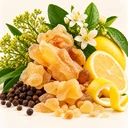
 Elemi Oil
Essential oil · Resinous / Citrus — resinous, lemony, peppery, fresh
-
 Frankincense Oil (Olibanum)
Essential oil · Resinous / Citrus — incense, resinous, lemony, smoky
-

 Lemon Oil (Cold-Pressed)
Essential oil · Citrus / Aldehydic — citrus, sharp, zesty, juicy
Used in formulas and accords
Used in 1 published formula
Elemi Resinoid is an ingredient in 1 accord in the Formula & Accord Library.
Further reading
Questions about Elemi Resinoid
Is Elemi Resinoid natural or synthetic?
Elemi Resinoid is natural. It is a solvent extract of a natural resin, balsam or gum.
Which published formulas use Elemi Resinoid?
Elemi Resinoid is used in 1 published formula in the RUŌOD Lab Formula & Accord Library: Honeyed Rose Accord. Each is listed with a link under "Used in formulas and accords" on this page.
Sources
- Scentspiracy — Elemi Resinoid — distributor's description.
- Première Peau — Elemi — published perfumery reference.
- Parchem — Elemi resinoid — distributor's description.
- Olfactory profile: the RUŌOD Lab team's synthesis of the published descriptions above, reviewed 26 October 2026. Evidence: more than one published description. Classification and the short description: revision 1. Descriptions of odour are judgement, not measurement.