

In short
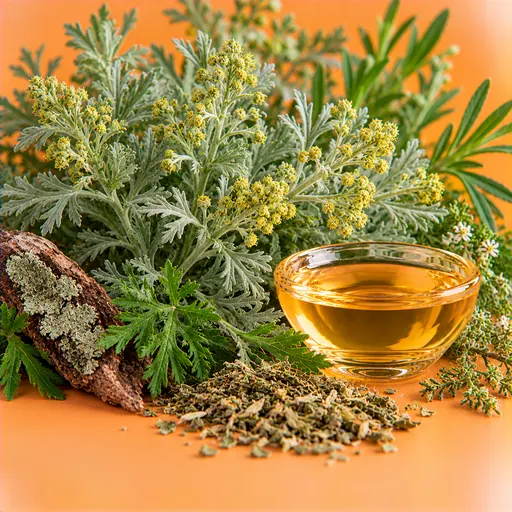
Armoise oil is distilled from Artemisia herba-alba. It has a bitter, herbal and camphoraceous odour with a sweet undertone and is used in fougères and chypres.
What Armoise Oil smells like
Armoise oil (Artemisia herba-alba) is fresh, herbaceous and camphoraceous. Eden Botanicals describes a cool, soft-green, sweet-camphoraceous aroma whose top note fades after a few minutes; New Directions a fresh-camphoraceous, somewhat green, bittersweet middle note; a supplier adds mineral-green undertones and notes its camphor, thujone and cineole content. Fraterworks links its thujonic character to absinthe. One retailer's claim that it is rich in thymol conflicts with the others.
- Leading note
- Sweet-green camphor
- Supporting facets
- Bittersweet, thujone, absinthe
- Faint facets
- Mineral-green
- Character
- Cool, fresh, herbaceous
What makes Armoise Oil distinctive
The absinthe herb: a cool, sweet-green camphor with thujone's bitter edge.
Where the descriptions disagree: One retailer says it is rich in thymol; the other sources describe camphor and thujone.
How Armoise Oil is used
Used in herbal, fougère and chypre compositions, within IFRA limits on thujone.
Typical role: modifier (used in small amounts to change the character of a blend).
How Armoise Oil differs from similar materials
- Sage Oil (Dalmatian)
- Sage is warmer and more herbaceous; armoise is cooler and sweeter-green, with a bitter edge.
- Davana Oil
- Davana, another Artemisia, is boozy and fruity; armoise is a cool, bitter-sweet camphor.
- Spirodecane
- Spirodecane gives a thujone-like herbal note from a synthetic ketal; armoise is the natural oil, sweeter and greener.
Each difference compares the published descriptions of the two materials. Smell varies with grade, supplier and dilution; compare them side by side on blotters before substituting one for another.
Formulation considerations
Contains thujone; check the regulatory position before use.
Identity and classification
- Type
- Essential oil
- Origin
- Natural
- Odour family
- Aromatic / Green
- Note position
- Top to heart note
- Physical form at room temperature
- Liquid
- Also known as
- Artemisia oil, White wormwood oil
- Botanical source
- Artemisia herba-alba
- CAS number
- 8008-93-3
The CAS number was checked on 19 October 2026 against a PubChem substance record that gives it for this material. A natural material is a mixture, so it has no single formula; its composition varies with origin and processing.
Safety and compliance
This page is general information, not a safety assessment or a specification. Confirm identity, composition, IFRA status and allergen content from your supplier's documents for the lot you hold.
Materials it works with
-

 Lavender Oil
Essential oil · Aromatic / Floral — lavender, herbal, floral, fresh
-
 Coumarin
Aroma chemical · Powdery / Fougère — hay, sweet, almond, tobacco
-

 Oakmoss Absolute
Absolute · Chypre / Green — mossy, earthy, inky, forest floor
-
 Clary Sage Oil
Essential oil · Aromatic / Amber — herbal, tea-like, ambery, musky
Armoise Oil is also suggested as a partner on the pages for Spirodecane.
Used in formulas and accords
Used in 1 published formula
Armoise Oil is an ingredient in 1 perfume formula in the Formula & Accord Library.
RUŌOD House Originals
Original compositions by RUŌOD House.
Further reading
Questions about Armoise Oil
Is Armoise Oil natural or synthetic?
Armoise Oil is natural. It is a volatile oil obtained from plant material by steam distillation or, for citrus peels, by cold expression.
What is the CAS number of Armoise Oil?
8008-93-3, the registry number for the essential oil as a substance rather than a single molecule. It was checked against PubChem on 19 October 2026.
Which published formulas use Armoise Oil?
Armoise Oil is used in 1 published formula in the RUŌOD Lab Formula & Accord Library: Mate Field. Each is listed with a link under "Used in formulas and accords" on this page.
Sources
- PubChem — substance 135331121, checked 19 October 2026.
- Eden Botanicals — Armoise (mugwort) — distributor's description.
- Scentspiracy — Armoise Maroc — distributor's description.
- Fraterworks — Armoise oil, Morocco — distributor's description.
- Biolandes — Armoise — manufacturer's description.
- Olfactory profile: the RUŌOD Lab team's synthesis of the published descriptions above, reviewed 26 October 2026. Evidence: more than one published description. Classification and the short description: revision 1. Descriptions of odour are judgement, not measurement.