

In short
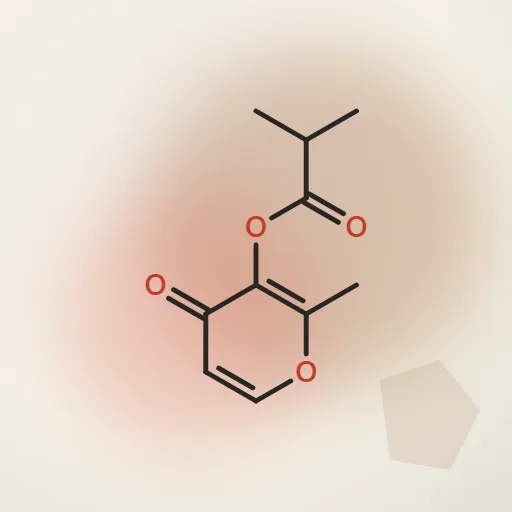
Maltyl isobutyrate is the isobutyric ester of maltol (FEMA 3462), with a sweet, fruity strawberry and caramel odour. It is more stable than maltol.
What Maltyl Isobutyrate smells like
Parchem describes maltyl isobutyrate as sweet and fruity with slight burnt, caramelised-sugar, jammy notes and a cotton-candy afterglow; ChemicalBook lists sweet strawberry, fruity, tropical berry and cotton candy. A flavourist panel found the neat odour sweet and brown and only slightly fruity, with raisin or dark-berry notes and caramel, malty, fermented qualities.
- Leading note
- Strawberry caramel
- Clear facets
- Caramel
- Supporting facets
- Jammy, cotton candy
- Character
- Sweet, warm
What makes Maltyl Isobutyrate distinctive
Maltol's caramel turned towards strawberry jam.
Where the descriptions disagree: Suppliers lead with strawberry; a flavourist panel found it brown and only slightly fruity, closer to raisin.
How Maltyl Isobutyrate is used
Used in gourmand and berry accords for a caramelised, jammy sweetness.
Typical role: modifier (used in small amounts to change the character of a blend).
How Maltyl Isobutyrate differs from similar materials
- Maltol
- Maltol is the caramel-candyfloss sweetener; its isobutyrate ester adds a fruity strawberry, jammy side.
Each difference compares the published descriptions of the two materials. Smell varies with grade, supplier and dilution; compare them side by side on blotters before substituting one for another.
Identity and classification
- Type
- Aroma chemical
- Origin
- Synthetic
- Odour family
- Gourmand / Fruity
- Note position
- Heart note
- Physical form at room temperature
- Liquid
- Also known as
- Maltol isobutyrate
- CAS number
- 65416-14-0
- Molecular formula
- C10H12O4
- Molecular weight
- 196.2 g/mol
- IUPAC name
- (2-methyl-4-oxopyran-3-yl) 2-methylpropanoate
The CAS number, formula and molecular weight are taken from PubChem compound 3354132, whose own record lists this CAS number; checked 24 October 2026.
Safety and compliance
Hazard classification of the neat substance, as PubChem summarises it, read 26 October 2026. Companies notifying the ECHA C&L Inventory classify it (1,448 reports): H317 may cause an allergic skin reaction (94.1% of reports). 86 of the reports find it does not meet the hazard criteria. A skin sensitiser classification concerns handling the neat material and the dose in a finished product; the IFRA Standards, where they apply, set the limits. Unless it is harmonised, this is the notifiers' own classification, not a binding one.
This page is general information, not a safety assessment or a specification. Confirm identity, composition, IFRA status and allergen content from your supplier's documents for the lot you hold.
Materials it works with
-

 Maltol
Aroma chemical · Gourmand / Fruity — caramel, sweet, bready, cooked fruit
-

 Ethyl Maltol
Aroma chemical · Gourmand / Fruity — candyfloss, caramel, sweet, jammy
-

 Furaneol
Aroma chemical · Gourmand / Fruity — strawberry, caramel, jammy, sweet
Used in formulas and accords
Used in 4 published formulas
Maltyl Isobutyrate is an ingredient in 2 perfume formulas and 2 accords in the Formula & Accord Library.
Community formulas
RUŌOD House Originals
Original compositions by RUŌOD House.
Further reading
Questions about Maltyl Isobutyrate
Is Maltyl Isobutyrate natural or synthetic?
Maltyl Isobutyrate is synthetic — it is made by chemical synthesis.
What is the CAS number of Maltyl Isobutyrate?
65416-14-0. It was checked against PubChem on 24 October 2026.
Which published formulas use Maltyl Isobutyrate?
Maltyl Isobutyrate is used in 4 published formulas in the RUŌOD Lab Formula & Accord Library, including Cherry Lacquer, Fur & Fruit and Pumpkin Accord. Each is listed with a link under "Used in formulas and accords" on this page.
Sources
- PubChem — compound 3354132, checked 24 October 2026.
- PubChem — GHS classification (the ECHA C&L Inventory notifications and any harmonised EU entry), read 26 October 2026.
- Parchem — maltyl isobutyrate — distributor's description.
- ChemicalBook — 65416-14-0 — odour database.
- Fraterworks — Maltyl Isobutyrate — distributor's description.
- Olfactory profile: the RUŌOD Lab team's synthesis of the published descriptions above, reviewed 24 October 2026. Evidence: more than one published description. Classification and the short description: revision 1. Descriptions of odour are judgement, not measurement.