
In short
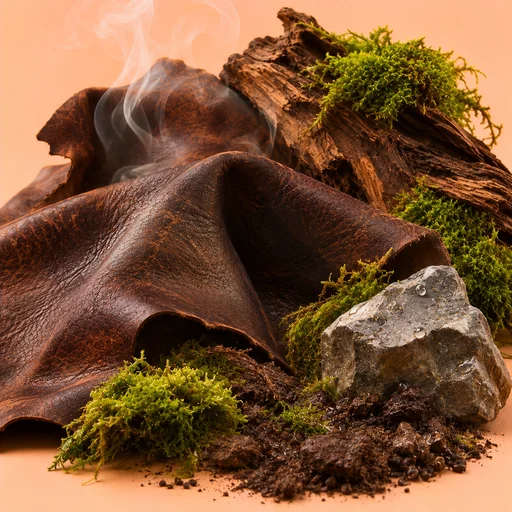
Isopropyl quinoline is a powerful leather-moss quinoline, earthier and more intense than isobutyl quinoline. It gives volume, strength and diffusion to masculine, chypre, vetiver and tobacco accords.
What Isopropyl Quinoline smells like
Givaudan calls isopropyl quinoline indispensable in masculine notes, blending with mossy vetiver, chypre and tobacco accords and with animal and spicy types, a rich and vibrant material whose influence is constant throughout evaporation; it lasts five days on a blotter. A Bedoukian safety sheet, via Haz-Map, records a colourless to yellow liquid with an earthy, woody odour. Fraterworks calls it isobutyl quinoline on steroids: metallic, earthy, green-leathery and character-defining at trace levels.
- Leading note
- Earthy leather
- Clear facets
- Woody
- Supporting facets
- Metallic, green moss
- Faint facets
- Smoke
- Character
- Powerful, diffusive, linear, dark
What makes Isopropyl Quinoline distinctive
The darker, earthier quinoline: leather with soil and metal in it rather than isobutyl quinoline's green, rooty leather.
How Isopropyl Quinoline is used
Fraterworks uses it with Haitian and Java vetiver, dry chypre bases, Mousse de Saxe-type bases and tobacco accords, and with isobutyl quinoline for a more dimensional leather.
Typical role: modifier (used in small amounts to change the character of a blend); fixative (slow to evaporate; helps a blend last and holds lighter notes).
How Isopropyl Quinoline differs from similar materials
- Isobutyl Quinoline
- Fraterworks calls isopropyl quinoline isobutyl quinoline on steroids: more intense and earthier, with a metallic edge, where isobutyl quinoline is the green, rooty classic leather. (compared directly by a cited source)
- 6-Methylquinoline
- 6-Methylquinoline is browner and more animalic, castoreum and tobacco with a wet-stone mineral facet; isopropyl quinoline is earthier, woodier and more mossy.
An asterisk marks a difference that a cited source states directly. The others compare the published descriptions of each material. Smell varies with grade, supplier and dilution; compare them side by side on blotters before substituting one for another.
Formulation considerations
Extremely strong; evaluate it well diluted. Commonly sold diluted in DPG.
Identity and classification
- Type
- Aroma chemical
- Origin
- Synthetic
- Odour family
- Leather / Woody
- Note position
- Heart to base note
- Physical form at room temperature
- Liquid
- Also known as
- 6-Isopropylquinoline
- CAS number
- 135-79-5
- Molecular formula
- C12H13N
- Molecular weight
- 171.24 g/mol
- IUPAC name
- 6-propan-2-ylquinoline
The CAS number, formula and molecular weight are taken from PubChem compound 67285, whose own record lists this CAS number; checked 7 November 2026.
Safety and compliance
Hazard classification of the neat substance, as PubChem summarises it, read 7 November 2026. Companies notifying the ECHA C&L Inventory classify it (316 reports): H315 causes skin irritation (100% of reports); H319 causes serious eye irritation (100% of reports); H302 harmful if swallowed (99.7% of reports); H310 fatal in contact with skin (99.4% of reports). Unless it is harmonised, this is the notifiers' own classification, not a binding one.
This page is general information, not a safety assessment or a specification. Confirm identity, composition, IFRA status and allergen content from your supplier's documents for the lot you hold.
Materials it works with
-

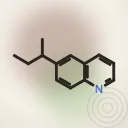 Isobutyl Quinoline
Aroma chemical · Leather / Green — leathery, earthy, green, smoky
-

 Vetiver Oil
Essential oil · Woody / Green — earthy, smoky, woody, rooty
-

 Oakmoss Absolute
Absolute · Chypre / Green — mossy, earthy, inky, forest floor
-
 Tobacco Absolute
Absolute · Leather / Gourmand — tobacco, honey, hay, leathery
-

 Castoreum Absolute
Absolute · Animalic / Leather — leathery, animalic, sweet, raspberry
-
 Labdanum Absolute
Absolute · Amber / Leather — amber, balsamic, leathery, animalic
Used in formulas and accords
Not currently used in any published formula.
The Formula & Accord Library lists Isopropyl Quinoline here as soon as a published formula, accord or base uses it.
Further reading
Questions about Isopropyl Quinoline
Is Isopropyl Quinoline natural or synthetic?
Isopropyl Quinoline is synthetic — it is made by chemical synthesis.
What is the CAS number of Isopropyl Quinoline?
135-79-5. It was checked against PubChem on 7 November 2026.
Sources
- PubChem — compound 67285, checked 7 November 2026.
- PubChem — GHS classification (the ECHA C&L Inventory notifications and any harmonised EU entry), read 7 November 2026.
- Givaudan — Isopropyl Quinoline — manufacturer's description.
- Fraterworks — Isopropyl Quinoline — distributor's description.
- PubChem — 6-isopropylquinoline (Haz-Map description) (CID 67285) — odour database.
- Olfactory profile: the RUŌOD Lab team's synthesis of the published descriptions above, reviewed 7 November 2026. Evidence: several independent published descriptions, which agree. Classification and the short description: revision 1. Descriptions of odour are judgement, not measurement.