

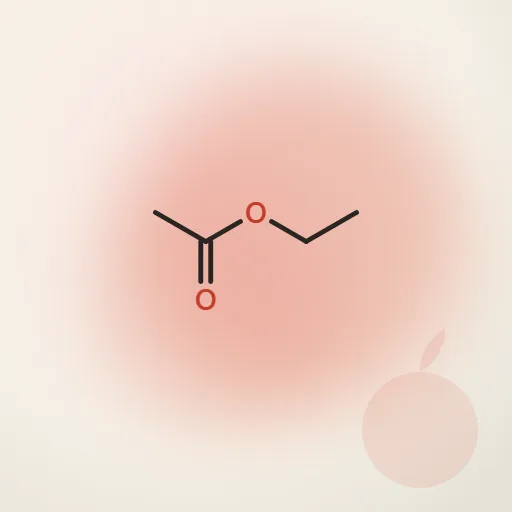
In short
Ethyl acetate is the simplest common fruity ester, found in fruit and fermented drinks. It has a light, ethereal, fruity odour and evaporates very quickly.
What Ethyl Acetate smells like
JECFA describes ethyl acetate as a colourless liquid, volatile at low temperatures, with a fragrant, acetic, ethereal odour. The Hazardous Substances Data Bank records an ether-like odour reminiscent of pineapple, and fruity with a brandy note. Fraterworks describes a sweet, ethereal, fruity aroma of pineapple, grape and pear drops, a highly volatile top note with ethereal liquor nuances of brandy and rum.
- Leading note
- Ethereal
- Supporting facets
- Pineapple, brandy
- Faint facets
- Acetic
- Character
- Volatile, light
What makes Ethyl Acetate distinctive
A thin, ethereal fruitiness that is gone in moments — the lightest of the fruity esters.
Concentration and dilution
Fraterworks also sells it as a 10% solution in DPG, and warns against inhaling it.
How Ethyl Acetate is used
Fraterworks uses it to give lift and brightness to top notes and to round off the rough edges of sharp top notes, and notes its use as an inexpensive solvent.
Typical role: lift (adds diffusion and radiance, especially at the top).
How Ethyl Acetate differs from similar materials
- Propionaldehyde
- Propionaldehyde is sharp and pungent; ethyl acetate is the softer, ethereal-fruity top note, and both are gone in moments.
Each difference compares the published descriptions of the two materials. Smell varies with grade, supplier and dilution; compare them side by side on blotters before substituting one for another.
Formulation considerations
Extremely volatile and highly flammable; it disappears from a blotter almost at once.
Identity and classification
- Type
- Aroma chemical
- Origin
- Occurs in nature
- Odour family
- Fruity
- Note position
- Top note
- Physical form at room temperature
- Liquid
- Also known as
- Ethyl ethanoate, Acetic ether
- CAS number
- 141-78-6
- Molecular formula
- C4H8O2
- Molecular weight
- 88.11 g/mol
- IUPAC name
- ethyl acetate
The CAS number, formula and molecular weight are taken from PubChem compound 8857, whose own record lists this CAS number; checked 24 October 2026.
Safety and compliance
Hazard classification of the neat substance, as PubChem summarises it, read 26 October 2026. It has a harmonised EU classification (Regulation (EC) No 1272/2008, Annex VI): H225 highly Flammable liquid and vapor; H319 causes serious eye irritation; H336 may cause drowsiness or dizziness. Companies notifying the ECHA C&L Inventory classify it (5,233 reports): H336 may cause drowsiness or dizziness (99.7% of reports); H319 causes serious eye irritation (91.1% of reports). 3 of the reports find it does not meet the hazard criteria. Unless it is harmonised, this is the notifiers' own classification, not a binding one.
This page is general information, not a safety assessment or a specification. Confirm identity, composition, IFRA status and allergen content from your supplier's documents for the lot you hold.
Materials it works with
-

 Ethyl Butyrate
Aroma chemical · Fruity / Gourmand — pineapple, fruity, sweet
-

 Isoamyl Acetate
Aroma chemical · Fruity / Gourmand — banana, pear drop, fruity, sweet
-

 Cognac Oil (Green)
Essential oil · Fruity / Green — winey, fruity, oily, cognac
Ethyl Acetate is also suggested as a partner on the pages for Propionaldehyde.
Used in formulas and accords
Used in 6 published formulas
Ethyl Acetate is an ingredient in 5 accords and 1 base in the Formula & Accord Library.
Further reading
Questions about Ethyl Acetate
Is Ethyl Acetate natural or synthetic?
The molecule occurs in nature. Commercial Ethyl Acetate may be made by synthesis or obtained from natural sources, so check the supplier's specification if the distinction matters to you.
What is the CAS number of Ethyl Acetate?
141-78-6. It was checked against PubChem on 24 October 2026.
Which published formulas use Ethyl Acetate?
Ethyl Acetate is used in 6 published formulas in the RUŌOD Lab Formula & Accord Library, including Açaí Accord, Blackberry Accord and Champagne Accord. Each is listed with a link under "Used in formulas and accords" on this page.
Sources
- PubChem — compound 8857, checked 24 October 2026.
- PubChem — GHS classification (the ECHA C&L Inventory notifications and any harmonised EU entry), read 26 October 2026.
- PubChem — Ethyl Acetate (CID 8857): JECFA organoleptic description — odour database.
- PubChem — Ethyl Acetate: Hazardous Substances Data Bank (HSDB) odour entry — odour database.
- Fraterworks — Ethyl Acetate — distributor's description.
- Olfactory profile: the RUŌOD Lab team's synthesis of the published descriptions above, reviewed 26 October 2026. Evidence: more than one published description. Classification and the short description: revision 1. Descriptions of odour are judgement, not measurement.